
Natural gas compressor selection is not a simplified version of industrial air compressor selection. Gas composition, molecular weight, pressure ratio, suction conditions, hydrocarbon liquids, corrosive components and hazardous-area requirements all influence which compressor type is appropriate — and what configuration within that type will perform reliably. This article explains how rotary screw, reciprocating and centrifugal compressors handle natural gas, where each type is technically suited, and what process data is needed before a selection can be made.
What Are the Main Natural Gas Compressor Types?
Three compressor families dominate natural gas and industrial gas compression duty:
- Rotary screw compressors — positive-displacement machines with helical rotors; suited to moderate-pressure-ratio service at steady flow conditions
- Reciprocating compressors — positive-displacement machines using pistons and cylinders; capable of high pressure ratios, multiple stages, and variable-flow operation
- Centrifugal compressors — dynamic machines using rotating impellers; suited to high-flow, relatively steady-state service where the gas molecular weight and operating envelope are compatible with the machine design
Each type compresses gas through a fundamentally different mechanism. The correct selection for a natural gas application depends on the combination of flow rate, pressure ratio, gas composition, suction conditions, turndown requirement and site constraints — not on any single factor alone. No one type is universally superior.

Why Gas Composition Changes Compressor Selection
A compressor specified for air cannot simply be reassigned to natural gas service. The engineering differences between compressed-air and natural gas compressor selection are significant enough to require independent analysis for every gas application.
The following process variables must be defined before compressor type selection is meaningful:
Gas composition
The molar fractions of methane, ethane, propane, heavier hydrocarbons, CO₂, H₂S, nitrogen, water vapour and any other components determine molecular weight, specific heat ratio (Cp/Cv), compressibility, condensation behaviour, materials requirements and sealing demands.
Molecular weight
Affects head development in centrifugal compressors and discharge temperature in all types. A centrifugal compressor designed for one gas cannot simply be redirected to a significantly different molecular weight without re-evaluation of the impeller and stage configuration.
Suction pressure and temperature
Determine the actual volumetric flow entering the machine and the thermodynamic starting point for compression. Both affect the calculated discharge temperature, the power requirement and the potential for liquid formation in the compression path.
Discharge pressure
Together with suction pressure, determines the pressure ratio. High pressure ratios typically require multi-stage compression. The pressure ratio also drives discharge temperature and influences compressor type selection.
Compressibility factor (Z)
Natural gas deviates from ideal-gas behaviour, particularly at higher pressures. The compressibility factor Z must be applied in head and power calculations. Using ideal-gas equations for high-pressure gas service introduces errors that become significant at higher pressures.
H₂S and CO₂
Hydrogen sulphide is corrosive and toxic and imposes requirements for sour-service materials (per NACE MR0175 / ISO 15156). CO₂ becomes corrosive in the presence of water. Both affect sealing and materials selection.
Hydrocarbon liquids
Liquid carryover into the compressor inlet is a serious risk in some gas streams. Compressor types differ in their sensitivity to liquid ingestion. Suction knock-out drums or scrubbers are typically installed upstream to protect the compressor, regardless of type.
Water content
Water vapour in natural gas can condense during compression and form hydrates under certain pressure-temperature conditions. This affects downstream treatment requirements, corrosion management and compressor design.
A standard industrial air compressor must never be used for natural gas service without a full engineering assessment. The flammability of natural gas, the corrosivity of sour components, the sealing requirements to prevent gas escape, and the materials and area-classification requirements for hazardous locations are not accommodated in air compressor designs.
How Rotary Screw Gas Compressors Work
A rotary screw compressor uses two intermeshing helical rotors — one male (with convex lobes) and one female (with concave flutes) — rotating in opposite directions within a precision-machined casing. Gas enters through the inlet port and is trapped in the decreasing volume between the rotor lobes as the rotors turn. As the trapped volume reduces, the gas is compressed and forced toward the discharge port.
The compression process is continuous — unlike a reciprocating compressor, there is no cyclical piston stroke and no discharge valve opening and closing with each cycle. This continuous-flow characteristic produces a relatively steady gas delivery without the pulsation inherent to reciprocating machines.
Oil-Flooded vs Dry Screw for Gas Service
In an oil-flooded rotary screw compressor, oil is injected into the compression space to seal clearances, remove heat of compression and lubricate the rotor surfaces. For gas service, this oil must be compatible with the gas composition — hydrocarbon gases will dissolve into some lubricants, changing their viscosity and potentially extracting hydrocarbon components from the gas stream. The selection and management of lubrication fluid for gas service requires specific attention.
In a dry (oil-free) screw compressor, the rotors run without fluid injection in the compression path. External timing gears maintain rotor-to-rotor clearances without metal-to-metal contact. For gas applications where oil contamination of the gas stream is unacceptable, a dry screw design keeps oil out of the compression path — but the discharge temperature is higher and two stages may be required for comparable efficiency at higher pressure ratios.
Gas Screw Compressor Characteristics
Rotary screw gas compressors are positive-displacement machines. Flow is largely determined by rotor speed — the machine delivers a relatively consistent volumetric flow across its operating pressure range (with some variation due to internal leakage at higher pressures). They are relatively compact for their flow range and can handle wet or dirty gas if suction scrubbing is adequate, depending on the specific design.
Screw compressors are sensitive to sustained liquid carryover. A single-stage screw compressor operating at moderate pressure ratios is typically a sound choice for gas gathering, low-to-medium pressure boosting and similar applications. For very high discharge pressures or very high pressure ratios, multiple stages or a different compressor type may be more appropriate — the actual limits depend on the specific machine design and gas conditions.
Project specifications for rotary gas compressors may reference API 619 (rotary-type positive-displacement compressors for petroleum, chemical and gas industry services). Whether API 619 is applicable depends on the project specification, owner requirements, service conditions and regulatory requirements — not every installation requires it.
How Reciprocating Gas Compressors Work
A reciprocating compressor uses one or more pistons driven by a crankshaft, each moving back and forth inside a cylinder. As the piston retracts, suction valves open and gas is drawn into the cylinder. As the piston advances, the suction valves close, the gas is compressed, and discharge valves open when compression pressure exceeds the discharge line pressure, expelling the compressed gas. The cycle repeats with each crankshaft revolution.
The cyclical nature of piston compression produces flow pulsations in the suction and discharge piping. These pulsations must be managed through pulsation dampeners, suction and discharge bottles, and piping design — particularly when sensitive instrumentation, control valves, or long piping runs are involved. Reciprocating compressors also produce higher vibration levels than rotary machines, which influences foundation design and skid packaging.
Multi-Stage Compression and Intercooling
For high pressure ratios, compression is divided across multiple stages, each with its own cylinder (or bank of cylinders). Between stages, intercoolers reduce the gas temperature back toward suction temperature before the gas enters the next stage. Intercooling reduces the work required for compression — the overall process approaches isothermal compression more closely than single-stage adiabatic compression — and also controls discharge temperature, which has materials and lubrication implications at high pressures.
This multi-stage, intercooled capability is a principal reason that reciprocating compressors are used for high-pressure gas service: CNG vehicle fueling, pipeline compression to high delivery pressure, industrial gas storage, and process applications requiring pressures that would be impractical in a single-stage machine of any design.
Valve and Packing Maintenance
Suction and discharge valves are wear components in reciprocating compressors. Valve failures are among the most common causes of unplanned downtime. Valve design, material selection (particularly for corrosive gases), and maintenance programme are critical operating considerations. Piston rings and rod packing also wear over time and require periodic replacement. For gas service, rod packing leakage is a containment issue — leaking packing allows flammable or toxic gas to escape into the compressor building. Non-lubricated piston rings and advanced packing designs are used where oil contamination of the gas must be prevented.
API 618 (reciprocating compressors for petroleum, chemical and gas industry services) is a reference standard that may be specified by project owners for these machines. Its applicability depends on the project specification and service classification.
How Centrifugal Gas Compressors Work
A centrifugal compressor uses rotating impellers to impart kinetic energy to the gas. The gas enters the impeller near its centre, is accelerated radially outward by the rotating blades, and then passes through a stationary diffuser that converts kinetic energy to pressure. Multiple stages — each with its own impeller and diffuser — are arranged in series to achieve higher overall pressure ratios.
The compression mechanism is fundamentally different from positive displacement. A centrifugal compressor does not trap a fixed volume of gas per revolution. Its performance is described by a characteristic curve: a relationship between flow rate and head (pressure rise) at a given speed. The actual operating point is determined by the intersection of this curve with the system resistance curve.
Surge and Choke
Two operating limits bound the usable range of a centrifugal compressor:
- Surge — occurs when flow falls below the minimum that allows stable compression. At surge, the pressure ratio the compressor can develop falls below the system backpressure, causing flow reversal in a cyclic and damaging oscillation. Anti-surge controls are required to keep the machine operating above its surge line.
- Choke (stonewall) — occurs at high flow when the gas velocity approaches sonic conditions in part of the flow path. Flow cannot increase further regardless of reduced system resistance. Operating at or near choke is not sustainable.
The range of stable operation between surge and choke defines the centrifugal compressor’s operating envelope. For applications requiring wide flow turndown, this envelope must be verified against the full range of expected operating conditions — and anti-surge systems must be properly designed and commissioned.
Molecular Weight Sensitivity
Centrifugal compressor performance is sensitive to the molecular weight of the gas. The head developed by an impeller at a given speed is determined by the velocity triangles — a function of impeller geometry and gas velocity. The pressure rise equivalent to that head depends on the gas density, which is a function of molecular weight, temperature and pressure. A centrifugal compressor designed and selected for natural gas (molecular weight approximately 16–20, depending on composition) cannot be used for a significantly lighter or heavier gas without re-evaluation of stage matching and operating point. If gas composition changes significantly during the project life, this must be communicated to the compressor manufacturer at the selection stage.
Sealing and Dry Gas Seals
High-speed centrifugal compressors typically use dry gas seals or wet (oil) seals to prevent gas from escaping along the shaft. Dry gas seals — which use a controlled gas film rather than contacting surfaces — are the predominant modern design for gas compressors and produce low seal gas leakage with minimal maintenance compared to older wet seal designs. Seal gas selection, conditioning and monitoring are important operating considerations, particularly for toxic or very high-pressure gases.
API 617 (axial and centrifugal compressors and expander-compressors for petroleum, chemical and gas industry services) is the relevant reference standard. Its applicability and required modifications depend on the project specification and service classification.
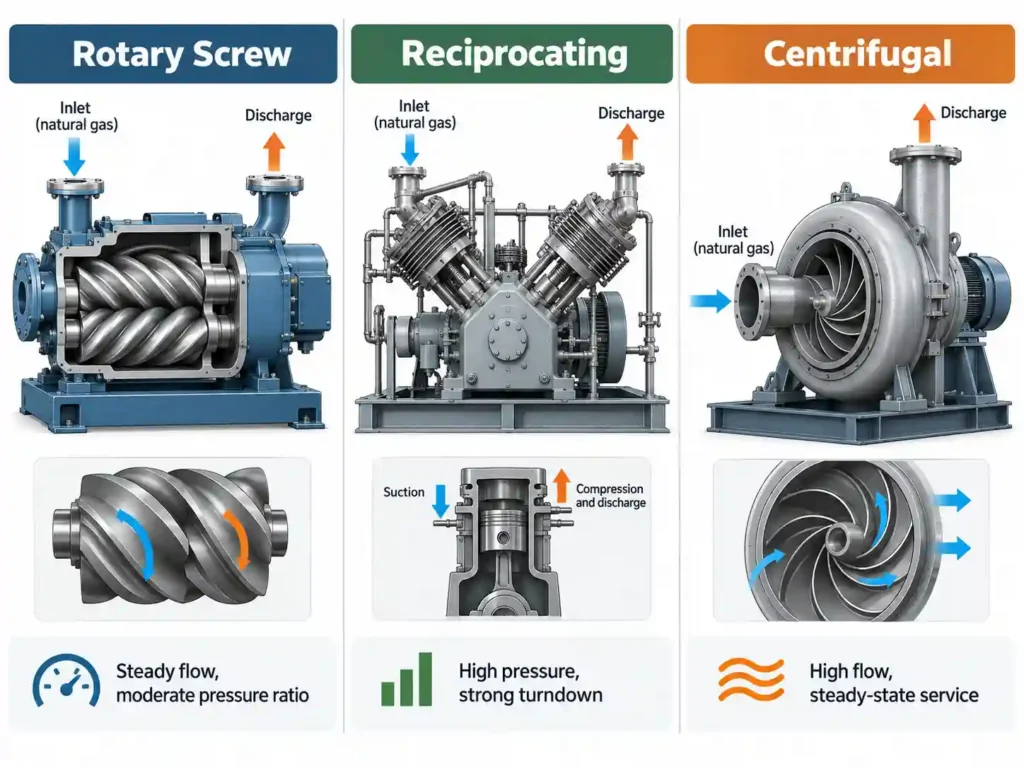
Screw vs Reciprocating vs Centrifugal — Comparison
| Characteristic | Rotary Screw | Reciprocating | Centrifugal |
|---|---|---|---|
| Compression principle | Positive displacement — continuous rotary | Positive displacement — reciprocating piston | Dynamic — velocity-to-pressure via impeller |
| Flow characteristic | Relatively constant volumetric flow at given speed; some capacity adjustment via speed or slide valve | Flow proportional to speed and cylinder configuration; step-wise unloading possible; variable-speed options available | Performance curve defines operating range; flow varies with system resistance at given speed; wide-flow-range applications may require variable speed or inlet guide vanes |
| Pressure ratio per stage | Moderate — typically up to a few bar in a single stage depending on design; higher ratios in multi-stage arrangements | Each stage capable of higher pressure ratio than a screw stage; multi-stage arrangements can achieve very high overall pressure | Moderate per stage; multiple stages in a single casing achieve high overall pressure; head per stage depends on gas properties and impeller design |
| Turndown capability | Moderate — variable speed or slide-valve unloading; some efficiency reduction at part load | Good — step-unloading by cylinder deactivation; variable-speed drive extends continuous turndown range | Limited by surge line; wide turndown requires anti-surge control, variable-speed drive or recycle systems |
| Gas composition sensitivity | Lubricant must be compatible with gas; materials selection required for H₂S, CO₂; molecular weight change has limited effect on flow characteristic | Valve and ring materials must suit gas composition; packing design for toxic or sour gas; molecular weight change affects cylinder capacity calculation | Performance is sensitive to molecular weight; impeller re-selection or restaging required for large composition changes |
| Liquid tolerance | Designs vary; some tolerance to liquid, depending on design; suction scrubbing recommended; slug ingestion damaging | Generally more robust to limited liquid than centrifugal; suction scrubbing still required; liquid slugs can cause serious damage (hydraulic lock) | Sensitive to liquid carryover; suction scrubbing essential; even small liquid quantities can damage impellers |
| Pulsation | Low — continuous rotary compression; minor pulsations from rotor geometry | Significant — inherent in piston action; requires pulsation dampeners, suction/discharge bottles and piping study | Low — continuous dynamic compression; surge events are violent and damaging |
| Vibration | Low to moderate; rotary balance; compact package | Higher — reciprocating forces require careful foundation design; larger footprint | Low at stable operating point; high speed requires precision balance and rotor dynamics assessment |
| Seal considerations | Shaft seals isolate gas from external; oil-flooded designs require oil-gas compatibility; dry designs require rotor clearance management | Rod packing prevents gas leakage to atmosphere; packing wear is a maintenance item and a containment risk for toxic or flammable gas | Typically dry gas seals or wet seals; seal gas conditioning system required; seal failure is a safety event for flammable or toxic gas |
| Maintenance character | Relatively predictable; rotor clearance, bearings, seals, lubricant management | Valves and packing are high-wear items with regular replacement intervals; higher maintenance intensity per unit of delivered flow | Generally low routine maintenance; seal system requires attention; major maintenance intervals typically longer than reciprocating |
| Relevant API standard | API 619 (where specified) | API 618 (where specified) | API 617 (where specified) |
Note: Descriptions are engineering characterizations, not absolute guarantees of performance. Actual behavior depends on specific machine design, gas conditions and operating context. Standards applicability depends on project specification and owner requirements.
Which Natural Gas Compressor Type Fits Which Duty?
No single compressor type is best for all natural gas applications. The following characterizes how duty type influences compressor selection. Final selection always requires actual process data.
Relatively steady, moderate-flow service at low to moderate pressure ratio
A rotary screw compressor is often a practical choice. Continuous rotary operation, relatively compact packaging and moderate maintenance intensity suit this type of duty. Examples include gas boosting at moderate suction-to-discharge ratios, fuel gas supply and wellpad compression where flow is relatively stable.
Variable-flow service requiring significant turndown
A reciprocating compressor with step-unloading, or a variable-speed screw compressor, can accommodate wider flow variation. For very wide turndown at moderate pressure ratio, a variable-speed screw or multi-cylinder reciprocating machine with individual cylinder loading should be evaluated. Centrifugal compressors are generally less suited to wide turndown without variable-speed drives or large recycle systems.
High-pressure multi-stage service (CNG, pipeline, high-pressure storage)
Multi-stage reciprocating compressors are widely used for this duty. Their ability to achieve high pressure ratios across multiple stages with intercooling, and their positive-displacement flow characteristic, suit high-pressure gas applications. For CNG stations and high-pressure process gas, see the CNG compressor selection guide for further detail on this specific application.
High-flow, relatively steady-state service at moderate overall pressure ratio
Large centrifugal compressors are typically used in pipeline boosting stations and LNG plant feed-gas compression where very high flow rates are required and the operating point is relatively stable. The machine must be designed for the specific gas composition and pressure conditions, and anti-surge control must be provided.
Gas with challenging composition (H₂S, CO₂, heavy hydrocarbons)
All three compressor types can be engineered for sour-gas service, but the materials, seal design and inspection requirements are significantly more demanding. Sour-service designs must comply with applicable standards (e.g., NACE MR0175 / ISO 15156 for H₂S) and must be discussed with the compressor manufacturer as part of the technical specification.
Applications with different gas properties or lighter molecular weight
For gas streams with molecular weights and physical properties significantly different from natural gas — such as hydrogen-rich streams — material compatibility, seal design and compression thermodynamics change substantially. See the hydrogen compressor selection guide for specific considerations around hydrogen compression.
How Gas Composition, Pressure Ratio and Flow Affect Selection
These three variables interact in ways that often eliminate one or two compressor types before the final selection is even started:
- Low pressure ratio + moderate flow: A screw compressor or small reciprocating machine are both candidates. The decision may rest on footprint, maintenance preference or process pulsation sensitivity.
- High pressure ratio, low-to-moderate flow: Multi-stage reciprocating compressors become the primary candidate. Screw machines can serve this range in multi-stage configurations but the economics and complexity may favor reciprocating.
- Very high flow, moderate pressure ratio: Centrifugal compressors are typically the correct technology. A reciprocating compressor at this flow rate would be physically very large, with high pulsation management demands.
- Highly variable flow: Variable-speed reciprocating or screw compressors are typically more capable of wide continuous turndown than centrifugal machines operating near their surge limit.
- Unusual gas composition: All three types require a gas-specific engineering assessment. There is no general answer that applies across compositions.
Sealing, Materials and Safety Considerations
Natural gas is flammable. Any compressed-gas leakage into a building or process area creates a safety hazard. The sealing design, seal monitoring systems, area classification and ventilation of the compressor installation are engineering requirements — not optional features.
For installations in hazardous areas (where flammable gas may be present), electrical equipment and instrumentation must be specified to the appropriate ATEX, IECEx or equivalent certification for the area classification. The compressor package, including drivers, controls and auxiliaries, must conform to the area classification. This requirement applies regardless of compressor type.
For gas containing H₂S above threshold concentrations, materials selection must comply with recognized standards for sour service. Failure to apply sour-service materials in the presence of wet H₂S can result in sulphide stress cracking of pressure-retaining components.
These safety requirements should be agreed at the project specification stage and documented in the technical requisition supplied to the compressor manufacturer.
What Information Should You Send for Gas Compressor Selection?
A natural gas compressor cannot be correctly selected without a complete set of process and project data. The following checklist covers the minimum information required for a technically valid selection:
Natural Gas Compressor RFQ Data Checklist
Final gas compressor selection requires this process data. A compressor selected without it will be based on assumptions that may not match site conditions — which affects both performance and safety. Providing complete data at the enquiry stage reduces the risk of selection errors and accelerates the technical review.
Request a Natural-Gas Compressor Recommendation
To receive a technically grounded compressor type recommendation for your natural gas application, provide the process data listed in the checklist above — particularly gas composition, required flow with reference basis, suction and discharge pressures, suction temperature, and hazardous-area classification. Visit the industrial gas compressor page to review available configurations, or contact the technical team directly with your process datasheet and project requirements to initiate a selection review.
Frequently Asked Questions
Can I use a standard industrial air compressor for natural gas?
No. An industrial air compressor is not designed for natural gas service. Natural gas is flammable, and the sealing, materials, area-classification requirements and gas containment standards for flammable-gas compression are fundamentally different from those for compressed air. Additionally, gas composition, compressibility and thermodynamic properties require gas-specific engineering assessments for performance prediction. Using an air compressor in natural gas service is not appropriate from a safety, mechanical or regulatory standpoint.
What causes a centrifugal compressor to surge, and how is it prevented?
Surge occurs when the flow through a centrifugal compressor drops below the minimum level at which the impeller can maintain stable compression. Below this point, the discharge pressure exceeds what the compressor can sustain, flow reverses in the machine, and the gas slams back — this cycle can repeat rapidly and damage impellers, seals and shaft components. It is prevented by anti-surge control systems that detect approach to the surge line (typically via flow and pressure monitoring) and respond by opening a recycle or blow-off valve to maintain flow above the surge limit. Anti-surge control must be correctly designed, calibrated and commissioned for the specific compressor and operating envelope.
Why does pressure ratio matter for compressor selection?
Pressure ratio (discharge absolute pressure divided by suction absolute pressure) determines how much work must be done per unit of gas and how high the discharge temperature rises. High pressure ratios increase discharge temperature significantly. Multi-stage compression with intercooling controls discharge temperature, reduces total compression power and enables very high overall pressure ratios. The maximum practical pressure ratio per stage varies by compressor type and design, so the required overall pressure ratio is a key factor in determining whether one stage or multiple stages — and which compressor type — is appropriate.
What is the significance of H₂S in gas compressor selection?
Hydrogen sulphide (H₂S) at concentrations above certain thresholds causes sulphide stress cracking in high-strength steel components under tensile stress. Wetness (free water) accelerates this mechanism. Compressor components including pressure casings, shafts, bolting and fasteners must be selected from materials that are resistant to sulphide stress cracking when the gas service is classified as sour per NACE MR0175 / ISO 15156 or equivalent applicable standard. H₂S is also acutely toxic at low concentrations, which affects area classification and personal protective requirements for the installation. Both aspects — materials and area classification — must be addressed in the project specification.
Do reciprocating compressors require special foundations?
Yes. The reciprocating forces from piston movement and crankshaft rotation produce cyclic loads and vibrations that must be transmitted to and absorbed by a suitable foundation. Reciprocating compressor installations typically require engineered concrete foundations or skid designs specifically analyzed for the compressor’s unbalanced forces. Incorrect or inadequate foundations can result in compressor movement, misalignment, piping fatigue failures and structural damage over time. Foundation design should be performed by a structural engineer using the mechanical forces provided by the compressor manufacturer.
Which compressor type is most efficient for natural gas compression?
There is no single answer. Centrifugal compressors at their design point can be highly efficient for large, steady-flow applications. Reciprocating compressors with intercooling approach isothermal efficiency and are well suited to high-pressure-ratio service. Screw compressors with water or oil injection provide near-isothermal compression in the moderate-pressure range. Efficiency comparisons are only valid when both machines are compared at the same flow, pressure and gas conditions — and at the specific operating points that reflect actual plant operation, not just the design point. Request specific power data (shaft power per unit of delivered flow) at the actual operating pressure and flow range for any direct comparison.