
A water-lubricated screw compressor uses injected water — rather than oil — to seal the compression chamber, remove heat and support rotor operation. Because no oil enters the compression path, it is an inherently oil-free compression process. This article explains exactly how water performs each of these functions, how air-water separation works, what downstream treatment is still required, and what a buyer should verify before selecting a water-lubricated model.
What Is a Water-Lubricated Screw Compressor?
A water-lubricated screw compressor is a rotary positive-displacement machine in which water — not oil — is injected into or circulated through the compression chamber formed by two intermeshing helical rotors. Water performs three functions simultaneously: sealing the clearances between rotors and casing, removing the heat generated during compression, and providing a fluid film that reduces mechanical contact and wear on rotating surfaces.
Because the fluid injected into the compression path is water rather than a hydrocarbon lubricant, oil cannot be introduced into the compressed air during the compression process itself. The compression path is therefore oil-free by design at the point where the air is compressed.
Water-lubricated designs are commercially available as fixed-speed and variable-frequency-drive (VFD) configurations. The CM/B and CM/PV models described later in this article represent two such configurations.
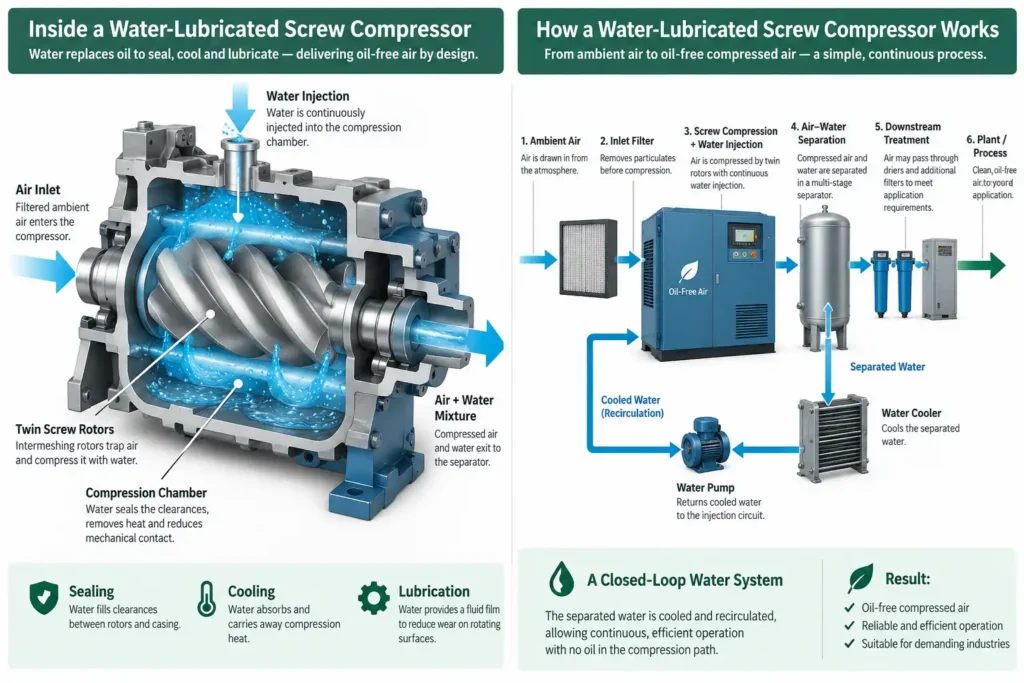
How Does a Water-Lubricated Screw Compressor Work?
+ Water Injection
Separation
& Recirculation
Treatment
Ambient air passes through an inlet filter to remove particulates before entering the compression chamber. Inside the chamber, two helical rotors turn in opposite directions, trapping air in the reducing volume between rotor lobes. Water is injected into this space continuously. The compressed air and water mixture exits the rotor chamber and enters a separator where the two phases are divided. The separated water is cooled and returned to the injection circuit; the compressed air continues to any required downstream treatment before entering the plant distribution system.
What Does the Water Actually Do?
Understanding the three roles of water in the compression process is important for evaluating the technology and for anticipating the maintenance requirements specific to water-lubricated systems.
| Water function | What happens | Engineering benefit | Buyer consideration |
|---|---|---|---|
| Sealing | Water fills the clearances between rotor profiles and between rotors and casing, preventing compressed air from leaking back to the inlet side | Volumetric efficiency is maintained without tight metal-to-metal clearances, and without requiring oil to perform the sealing function | Water quality matters — contaminants or scale formation can affect sealing effectiveness; water treatment must be specified and maintained |
| Cooling | Water absorbs the heat of compression directly in the rotor chamber; discharge air temperature is substantially lower than in a dry oil-free compressor | Lower discharge temperature simplifies downstream moisture management; compression is closer to isothermal, which is thermodynamically favorable and reduces specific energy input compared to adiabatic compression | The efficiency advantage of near-isothermal compression depends on operating conditions; buyers should obtain specific-power data (kW per m³/min or kW/100 CFM) at the actual operating pressure |
| Lubrication | The water film between rotor surfaces and between rotors and casing reduces friction and wear; many water-lubricated designs also use composite or engineered rotor materials to assist rotor durability | Enables operation without hydrocarbon lubricant in the compression path, directly preventing oil contamination of the compressed air stream | The rotor material selection and water quality together determine long-term wear behavior; confirm manufacturer recommendations for water hardness, pH and conductivity |
How Does the Compressor Keep Oil Out of the Compression Chamber?
The key engineering point is that oil is kept out because it is never introduced in the first place. In a water-lubricated screw compressor, the compression path — from inlet to discharge — contains only air and water. The lubrication of the rotor bearings and gear systems (which are external to the compression chamber) uses conventional lubricants, but these are mechanically isolated from the air path by shaft seals. The design is intended to ensure that these external lubricants do not migrate into the compression chamber under normal operating conditions.
The sealing arrangement between the oil-lubricated bearing sections and the water-flooded rotor chamber is a critical design element. Buyers evaluating specific compressor models should ask the manufacturer to explain the sealing configuration, what happens to that seal over time, and what maintenance is required to preserve the integrity of this separation.
This design philosophy differs fundamentally from an oil-injected screw compressor, where the lubrication fluid is deliberately injected into the compression space and must then be removed from the compressed air downstream through a separator and filters. It also differs from a dry oil-free screw compressor, where the rotors run without any fluid injection at all, which produces higher discharge temperatures and typically requires two compression stages with intercooling.
What Happens to Water After Compression?
The air-water mixture leaving the rotor chamber enters a separator. In the separator, inertia and gravity effects (and sometimes coalescing media) cause water droplets to fall out of the airstream. The bulk of the injected water is collected in the separator sump and returned to the injection circuit after passing through a cooler that brings the water back to an acceptable injection temperature.
A small amount of water remains in the compressed air leaving the separator as vapour and fine droplets. This is normal and expected — it does not represent a system failure. The separated compressed air will contain water vapour at a concentration that depends on the compression conditions and the separator efficiency.
Water Treatment Considerations
The circulated water will gradually accumulate dissolved minerals, biological contaminants and potentially particulates from the inlet air. Without treatment or regular replacement, water quality will deteriorate and can lead to scaling on heat-exchanger surfaces, corrosion, rotor-surface deposits and changes in sealing effectiveness.
Manufacturers typically specify water quality parameters (pH, hardness, conductivity, dissolved oxygen) and may recommend demineralized or deionized water, or a specific water treatment programme. Buyers should request the water specification alongside the mechanical specification and factor water treatment into operating cost assessments.
Does Water-Lubricated Mean ISO Class 0?
This is one of the most common misunderstandings in oil-free compressor procurement. The two questions — whether a compressor is water-lubricated and whether the compressed air it produces meets ISO 8573-1 Class 0 — are related but not automatically equivalent.
ISO 8573-1 Class 0 is the most demanding tier of the compressed-air quality classification standard for oil contamination. It requires that the oil concentration be at or below a level agreed between the equipment user and supplier — in effect, below the minimum detectable limit for an agreed test method. It does not mean zero contamination in an absolute mathematical sense.
A water-lubricated compressor can achieve an oil-free compression process because no oil is introduced into the compression path. However, whether the compressed air delivered by any specific machine under specific conditions at a specific measurement point meets ISO 8573-1 Class 0 for oil aerosol, vapour and total oil content depends on:
- The effectiveness of the mechanical separation between the bearing lubrication and the compression chamber
- The inlet air quality — if the incoming air contains oil vapour from the environment, a compressor cannot remove it without appropriate downstream filtration
- The downstream treatment provided (filters, dryers)
- The specific test method and conditions under which the compressor was assessed
If ISO 8573-1 Class 0 certification is required for a particular application, buyers must request the test documentation for the specific compressor model and configuration, tested under conditions representative of the actual duty. Stating that a compressor is “oil-free” is not the same as providing documented ISO 8573-1 Class 0 test results. See the ISO 8573 Class 0 air quality guide for a detailed explanation of what this classification requires and how it should be verified.
Oil-Free Does Not Mean No Downstream Treatment Required
Even when a water-lubricated compressor genuinely produces oil-free compressed air, the compressed air leaving the compressor will contain water vapour. At high enough temperatures or when the air cools in the distribution system, this water vapour will condense. Condensed water in pipework, pneumatic equipment, or process instruments causes corrosion, equipment failure and production interruptions.
The type and extent of downstream treatment depends on the required air quality for the specific application:
- Refrigeration dryers — remove bulk condensed water and reduce the pressure dew point, typically to +3°C. Suitable for general industrial air systems where a low dew point is not required.
- Desiccant dryers — remove water vapour to a much lower pressure dew point (typically −20°C to −70°C or lower). Required for sensitive processes, instrument air, or where low-temperature conditions may be encountered.
- Coalescing and particulate filters — remove fine water aerosols and particles from the airstream. The required filter grades depend on the downstream quality specification.
Selecting a water-lubricated compressor for an oil-sensitive application without specifying the downstream treatment is incomplete system design. The compressor and the treatment system should be sized and specified together.
Water-Lubricated vs Oil-Injected vs Dry Oil-Free Screw Compressors
| Characteristic | Water-Lubricated Screw | Oil-Injected Screw | Dry Oil-Free Screw |
|---|---|---|---|
| Fluid in compression path | Water | Oil | None |
| Oil in compressed air | Not introduced in compression path; relies on bearing-seal integrity | Present — removed by downstream separator and filters to a residual level | Not introduced in compression path; relies on bearing-seal integrity |
| Discharge temperature | Relatively low — water cooling acts within the compression chamber | Moderate — oil cooling lowers temperature compared to dry compression | Higher — no internal cooling fluid; may require two stages with intercooling |
| Compression stages | Typically single stage for moderate pressures | Typically single stage for standard industrial pressures | Often two stages with intercooling for comparable pressure and efficiency |
| Water management downstream | Water vapour present in compressed air — dryer required for most applications | Water vapour present — dryer required for most applications; oil-water condensate requires disposal | Higher discharge temperature means more water vapour — dryer required |
| Maintenance focus | Water quality, separator, rotor surfaces, bearing seals | Oil change and analysis, separator element, oil filters | Rotor timing gear, bearing lubrication (external), shaft seals |
| Environmental consideration | No oil-contaminated condensate in compression path; water discharge may require treatment depending on local regulations | Oil-water condensate from downstream drains requires proper disposal | No oil-contaminated condensate from the air circuit |
| Typical application driver | Oil-sensitive processes, food, pharma, electronics, where oil-free air is required and downstream treatment is manageable | General industrial compressed air where residual oil in air is acceptable after filtration | Oil-sensitive processes requiring verified oil-free air; often used at higher pressures or where water injection is not acceptable |
Where Are Water-Lubricated Compressors Used?
Water-lubricated oil-free screw compressors are used where the compressed air comes into contact — directly or indirectly — with products where oil contamination would be unacceptable. Common sectors include:
Food and beverage
Packaging, conveying, filling, blowing, direct product contact — any application where oil in air could contaminate the product
Pharmaceutical
Process air, instrument air, pneumatic transport — often subject to GMP requirements for air quality documentation
Electronics and semiconductor
Precision cleaning, wafer processing, assembly — oil contamination affects surface quality and process yield
Textiles
Air jet weaving and fiber processing — oil deposits on yarn or fabric represent a quality defect
Medical device manufacturing
Compressed air used in device assembly or testing where traceability of air quality is important
Chemical and general process
Where oil contamination of the process or of instrumentation must be prevented
Water-lubricated designs are not inherently superior in every application — they involve specific maintenance requirements and are typically used where the oil-free requirement justifies the additional water-management disciplines. For applications where residual oil in compressed air is acceptable after filtration, an oil-injected screw compressor may be a more straightforward and cost-effective solution.
What Should an Industrial Buyer Verify?
Buyer Verification Checklist — Water-Lubricated Oil-Free Screw Compressor
CM/B and CM/PV Water-Lubricated Compressor Options
Two water-lubricated water-lubricated oil-free compressor configurations are available in this range, covering both fixed-speed and variable-frequency-drive operation:
Fixed-speed water-lubricated oil-free screw compressor. Suited to applications with relatively stable, continuous compressed-air demand where flow control by speed adjustment is not required. The fixed-speed configuration typically involves lower initial investment than a VFD equivalent where continuous variable-flow operation is not needed.
Permanent magnet VFD water-lubricated oil-free screw compressor. The permanent magnet motor combined with variable-frequency drive allows the compressor to modulate output in response to demand variation, avoiding the inefficiency of fixed-speed unloaded running. For applications with variable demand profiles, the VFD configuration typically delivers lower energy consumption over the operating period than a fixed-speed equivalent.
For a side-by-side comparison of how these two configurations perform under different demand profiles, see CM/B vs CM/PV selection guide. Both models should be evaluated against the buyer verification checklist above before selection, with performance data confirmed at the actual operating pressure and site conditions.
To receive a technical recommendation for the CM/B or CM/PV series, provide the required flow and reference basis, minimum working pressure, site altitude and ambient conditions, duty cycle, and required air quality class. Contact the team with this information to confirm the appropriate model and specify any downstream treatment required for the application.
Frequently Asked Questions
Is a water-lubricated compressor the same as a water-cooled compressor?
No. A water-cooled compressor uses water in an external heat exchanger (aftercooler) to cool the compressed air or the compressor’s oil after compression has taken place. The water never enters the compression chamber. A water-lubricated compressor injects water directly into the compression chamber itself, where it serves sealing, cooling and lubrication functions during the compression process. Both types may use external water for secondary cooling as well.
Does the water-lubricated compressor produce oil-free compressed air?
Oil is not introduced into the compression path in a water-lubricated design — so the compression process itself is oil-free. However, trace contamination from the bearing areas cannot be categorically ruled out for any machine without reviewing the specific sealing design and test data. Additionally, if the inlet air contains environmental oil vapour, the compressor cannot remove it. For oil-sensitive applications, the complete system — compressor plus downstream filtration — must be specified and tested together.
What quality of water is required?
Manufacturer specifications vary, but typically water-lubricated compressors require water with controlled hardness, pH and conductivity to prevent scaling, corrosion and biological growth in the water circuit. Many manufacturers specify deionized or demineralized water, or a particular treatment programme. Using tap water without treatment in a climate or geographic area with high mineral content will typically cause scale deposits and reduced component life. The water specification must be obtained from the manufacturer and maintained throughout the compressor’s operating life.
Do I still need a dryer if I use a water-lubricated oil-free compressor?
Yes. The compressed air leaving a water-lubricated compressor contains water vapour. When this air cools in the distribution system, the vapour condenses. Condensed water in the pipework causes corrosion, reduces the life of pneumatic actuators, contaminates sensitive instrumentation and degrades process quality. A refrigeration or desiccant dryer is required depending on the dew-point specification for the application. The dryer specification is part of the compressed-air system design, not an optional addition.
How does a permanent magnet VFD motor improve efficiency?
A permanent magnet motor maintains high efficiency across a wider speed range than an induction motor. When combined with a VFD, the compressor can reduce its output in proportion to actual demand rather than running at full load and unloading when demand falls. At part load, this produces genuine energy savings compared to a fixed-speed machine that continues to consume a large fraction of full-load power even when unloaded. The actual energy saving depends on the demand profile — plants with highly variable air demand benefit most from VFD control.
What maintenance is specific to water-lubricated compressors compared to oil-injected machines?
Instead of oil changes, the maintenance programme for a water-lubricated compressor centres on water quality monitoring and treatment, separator element inspection and replacement, and inspection of the shaft seals that isolate the bearing lubrication from the water circuit. Rotor surface condition should also be monitored over the operating life. The frequency and scope of these tasks depend on the specific model and the water quality maintained — the manufacturer’s maintenance schedule should be followed and water analysis performed at the recommended intervals.