
Natural Gas Compressor Selection for CNG Stations: It Starts With Seven Numbers
Every CNG station project hits the same moment. Someone asks the compressor supplier for a price, and the supplier comes back with ten questions. It feels like stalling. It is not. A CNG compressor that looks right on paper but was sized on the wrong suction pressure will either starve your dispensers at rush hour or run itself ragged trying to keep up.
This guide walks through CNG compressor selection the way a station engineer would do it: inlet pressure, discharge pressure, fill rate, storage, duty cycle, gas quality and hazardous-area requirements. Get those seven inputs right and the compressor almost picks itself. Get one wrong and you will be explaining it to the fleet manager every cold morning in January.
The short answer
To size a CNG station compressor, confirm seven things: minimum and maximum inlet (suction) pressure, required discharge pressure, peak-hour and daily gas demand, storage volume and cascade layout, duty cycle and redundancy, gas composition and water content, and the hazardous-area and code requirements at your site.
Suction pressure sets the number of stages and how much gas each unit delivers. Fill rate and storage set the capacity. Gas quality and hazardous-area rules set the treatment and the package design.
Know Your Station Type Before You Talk Compressors
The station layout decides what the compressor has to do. Here are the common configurations and what each means for equipment choice.
| Station type | Gas source | What the compressor has to do |
|---|---|---|
| Standard (online) fast-fill station | Local gas pipeline | Compress pipeline gas to storage pressure, refill cascade banks between vehicles |
| Time-fill fleet depot | Local gas pipeline | Fill parked vehicles slowly overnight, little or no storage |
| Mother station | High-capacity pipeline connection | Fill tube trailers at high flow, often with large suction pressure available |
| Daughter station | Tube trailer delivered by truck | Boost gas left in the trailer as its pressure falls, so suction swings widely |
| Combination fast and time fill | Local gas pipeline | Public fast fill by day, fleet time fill at night on the same compressors |
How to Do CNG Compressor Selection: A 7-Step Workflow
Work through these steps in order. Each one feeds the next, and skipping ahead is how stations end up with a compressor that is perfect for somebody else.
Step 1: Confirm the inlet pressure range, not just one number
Suction pressure is the single most important input. It decides how many compression stages you need, how much gas each machine delivers and how much power it draws. Ask the gas utility for the minimum guaranteed pressure and the maximum possible pressure at your meter, including winter lows when network demand peaks.
Why the range matters: delivered gas is roughly proportional to absolute suction pressure. If a unit is rated at 3 bar(g) suction (4 bar absolute) and the network sags to 2 bar(g) (3 bar absolute) on a cold morning, you lose about a quarter of your capacity right when every fleet vehicle is lining up.
Stage count follows the overall pressure ratio. Reciprocating CNG compressors typically run around 3:1 per stage to keep discharge temperature under control, which most designs hold below roughly 150 °C per stage.
| Suction pressure | Discharge pressure | Overall ratio (absolute) | Typical stages |
|---|---|---|---|
| 0.5 bar(g), low-pressure main | 250 bar(g) | about 167 | 4 to 5 |
| 3 bar(g), medium-pressure main | 250 bar(g) | about 63 | 4 |
| 10 bar(g) | 250 bar(g) | about 23 | 3 |
| 25 bar(g), high-pressure line | 250 bar(g) | about 10 | 2 |
Higher suction pressure means fewer stages, less power per Nm³ and a smaller machine for the same output. If a higher-pressure line runs near your site, the connection cost is often worth pricing against the compressor savings.
Step 2: Set the discharge pressure for your market
Discharge pressure follows the vehicle cylinder standard where you operate:
- 200 bar vehicle systems (Europe, Asia, South America, much of the Middle East): stations typically store and dispense at around 250 bar.
- 3,600 psi vehicle systems (Canada and the US): fast-fill storage typically runs around 4,500 psi (about 310 bar) so the dispenser can deliver a full, temperature-compensated fill.
- Tube trailers: check the trailer rating, commonly in the 200 to 250 bar range, and match the mother station discharge to it.
Do not overshoot. Every extra bar of discharge pressure costs energy and pushes up stage temperatures. Build in the margin the dispenser and storage actually need, then stop.
Step 3: Calculate fill rate and daily demand
Now figure out how much gas leaves the station, and when. Start with the vehicle mix. The figures below are rough planning numbers, so always check your actual fleet cylinder capacity.
| Vehicle | Typical gas per fill (Nm³) |
|---|---|
| Passenger car or taxi | 15 to 25 |
| Light commercial van | 30 to 50 |
| Transit bus | 200 to 350 |
| Refuse truck or heavy truck | 200 to 400 and up |
For fast-fill stations, the number that matters is the peak hour. Daily volume tells you about annual running hours, but the compressor and storage together must survive the busiest hour without letting dispenser pressure sag. For time-fill depots, the math is simpler: required capacity equals total gas for the fleet divided by the hours in the fill window.
Step 4: Size storage and the priority panel
Storage lets a smaller compressor handle short bursts of demand. The catch is that only part of the stored gas is usable for fast fill, because bank pressure has to stay above the vehicle cylinder pressure to keep gas flowing. A three-bank cascade (low, medium and high) with a priority panel raises that usable share by filling vehicles from the low bank first and topping up from the high bank.
The trade-off is straightforward. More storage lets you buy a smaller compressor, but storage takes space, needs inspection and adds its own code requirements. Less storage means a bigger compressor that starts and stops more often. The sweet spot depends on how spiky your demand is.
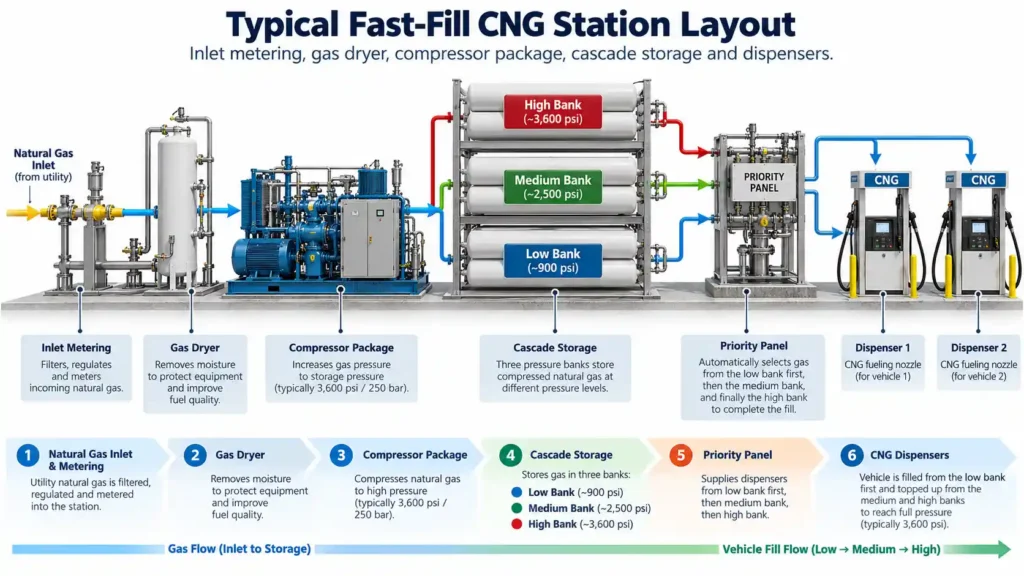
Typical fast-fill CNG station: inlet metering, gas dryer, compressor package, cascade storage and dispensers.
Step 5: Define the duty cycle and redundancy
A compressor that runs 20 hours a day is a different beast from one that starts 15 times an hour to top up storage. Tell your supplier which one you have.
- Running hours per year: drives valve, ring and packing service intervals, and whether a heavier-duty frame is worth it.
- Starts per hour: large motors have start limits. A soft starter or VFD helps, and so does enough storage to stretch run times.
- Redundancy: a public station with one compressor goes dark during every service visit. Two smaller units usually beat one big one for availability.
- Cooling: air-cooled packages are simpler, but check the hottest summer day and any enclosure heat buildup. Water-cooled suits high-duty mother stations.
Step 6: Check gas quality and plan treatment
Pipeline gas is not always vehicle-ready. Get a recent gas analysis and look at these items:
- Water content: water that is harmless at pipeline pressure can condense or form hydrates at 250 bar and freeze in a Prairie winter. Vehicle fuel guidance such as ISO 15403 and SAE J1616 ties the water limit to the coldest ambient temperature. Most stations install a twin-tower desiccant dryer, either at low pressure before the compressor or at high pressure after it.
- Sulfur and H2S: corrosive to compressor valves and vehicle cylinders. High values need removal upstream.
- Heavy hydrocarbons: can condense at high pressure and end up as liquid in storage or vehicle tanks.
- Compressor oil carryover: lubricated cylinders pass some oil into the gas. Coalescing filters after the final stage protect vehicle regulators and injectors.
- Particles: pipeline dust and construction debris need an inlet filter, especially on new connections.
Step 7: Match hazardous-area and code requirements
A CNG compressor handles flammable gas at high pressure, so the package has to fit the local rulebook from day one. Retrofitting certification is expensive and slow.
- Codes: CSA B108 in Canada, NFPA 52 in the US, ISO 16923 internationally, plus local fire and pressure equipment rules.
- Area classification: Class I Division 1 or 2 under North American codes, Zone 1 or 2 under IEC and ATEX. Motors, instruments, lighting and panels inside the zone must carry matching certification.
- Safety systems: gas detection, forced ventilation, fire detection, emergency shutdown, relief valves and a safe vent or blowdown system.
- Pressure equipment: ASME, PED or local approval for vessels, piping and storage, depending on the country.
- Noise: urban stations near homes often need an acoustic enclosure. Put the noise limit in your spec, not in your apology letter.
Worked Example: An Urban Taxi and Van Station
Here is how the seven steps come together for a public fast-fill station serving taxis and delivery vans.
| Input | Value |
|---|---|
| Suction pressure range | 2.5 to 4 bar(g), design on 2.5 |
| Discharge pressure | 250 bar(g), 200 bar vehicles |
| Daily fills | 350 taxis at 18 Nm³, 50 vans at 40 Nm³ |
| Daily demand | 6,300 + 2,000 = 8,300 Nm³ |
| Peak hour (about 14 percent of daily) | about 1,160 Nm³/h |
| Storage | Three-bank cascade covering short bursts above compressor output |
| Compressor plan | 2 units at about 600 Nm³/h each, rated at 2.5 bar(g) suction, 4 stages |
Both units run through the rush hours. Off-peak, one unit keeps storage topped up while the other rests, and when one is down for service the station still sells gas instead of putting up a closed sign. Rating the machines at the low end of the suction range means winter pressure sags cost you margin, not customers.
Which Compressor Type Fits Which CNG Station?
| Type | Best fit | Watch-outs |
|---|---|---|
| Multi-stage reciprocating | Standard, time-fill and mother stations, the workhorse of CNG | Valve and packing maintenance, vibration, oil carryover on lubricated designs |
| Hydraulic-driven booster | Daughter stations with wide suction swings from tube trailers | Lower flow per unit, hydraulic system upkeep |
| Screw first stage plus reciprocating | Very low suction pressure with high flow | More complex package, two machine types to maintain |
For a deeper comparison of designs, drive options and where each makes sense, read our guide to natural gas compressor types.
Our CMT industrial gas compressor for natural gas is configured around your suction range, discharge pressure and flow, with ATEX and IECEx compliant packages for hazardous areas and ASME pressure equipment available on request.

Skid-mounted natural gas compressor package for CNG station duty.
Look at Total Cost, Not Just the Quote
Two CNG station compressors with similar prices can end up thousands of dollars apart per year. Compare these line by line:
- Specific energy: kWh per Nm³ at your actual suction pressure. From low-pressure mains it is commonly in the 0.2 to 0.35 kWh/Nm³ range, and much less from high-pressure lines.
- Service intervals: hours between valve, ring and packing work, and what a full overhaul costs.
- Availability: every hour your station is down is lost fuel sales and annoyed fleet customers.
- Gas losses: blowdown recovery systems capture gas vented at shutdown instead of sending it to atmosphere.
- Parts and support: lead time on valves and seals, and whether someone can reach site within your required response time.
Common Mistakes on CNG Station Projects
- Sizing on average suction pressure, then losing capacity every winter morning.
- Sizing on daily volume instead of the peak hour.
- Skipping the gas dryer because the utility said the gas is dry. Dry at 3 bar is not the same as dry at 250 bar.
- One large compressor at a public station, so every service visit means a closed sign.
- Ordering a standard package, then discovering the site sits in a Division 1 or Zone 1 area.
- Forgetting power supply capacity until the utility quotes six months for a transformer.
RFQ Checklist: What to Send Your Compressor Supplier
Send this list with your inquiry and you will get a real proposal on the first round, not a pile of questions.
- ☐ Station type: standard fast fill, time fill, mother, daughter or combination
- ☐ Inlet pressure: minimum, normal and maximum, with units
- ☐ Required discharge pressure and vehicle cylinder standard
- ☐ Required flow in Nm³/h or SCFM, peak hour and daily volume
- ☐ Vehicle mix and fill window for fleets
- ☐ Planned storage volume and cascade layout, if already decided
- ☐ Gas analysis, including water content and sulfur
- ☐ Hazardous-area classification and applicable codes
- ☐ Power supply voltage, frequency and available capacity
- ☐ Ambient temperature range, altitude and noise limits
- ☐ Redundancy expectations and required availability
FAQ: CNG Compressor Selection
What is the most important factor in CNG compressor selection?
Inlet pressure, and especially its minimum value. It sets the number of stages, the gas delivered per machine and the power draw. Always rate the compressor at the lowest suction pressure you expect to see.
What discharge pressure does a CNG station compressor need?
For 200 bar vehicle systems, stations usually store at around 250 bar. For 3,600 psi vehicles in Canada and the US, fast-fill storage typically runs near 4,500 psi. Mother stations match the tube trailer rating.
How do I calculate CNG compressor capacity?
For fast fill, estimate peak-hour demand from your vehicle mix, then choose compressor capacity and storage together so the busiest hour is covered. For time fill, divide total fleet gas demand by the hours in the fill window.
Is fast fill or time fill better for a fleet?
Time fill suits fleets that park overnight at one depot, such as refuse trucks and school buses, since it needs less storage and gives fuller fills. Fast fill suits public stations and fleets that refuel during shifts. Many depots combine both.
Do I need a gas dryer at a CNG station?
In most cases, yes. Water that stays as vapor at pipeline pressure can condense or form hydrates at storage pressure, especially in cold climates. Fuel quality guidance ties the water limit to your coldest ambient temperature.
One large compressor or two smaller ones?
For public stations, two smaller units usually win. You keep selling gas during service, you match low demand better, and the capital cost difference is often smaller than people expect.
Which codes apply to CNG station compressors?
CSA B108 in Canada, NFPA 52 in the US and ISO 16923 internationally, along with local hazardous-area rules (Class and Division, or ATEX and IECEx zones) and pressure equipment regulations.
Get a CNG Compressor Sized for Your Actual Site
Send us your inlet pressure range, required outlet pressure and flow. Add your vehicle mix, gas analysis and hazardous-area classification if you have them. Our engineers will come back with stage count, unit sizing, treatment and package options for your station.
Still early in planning? Inlet pressure, outlet pressure and a rough daily volume are enough for a first sizing.