
Oil-Free Compressor for the Food Industry: Why Class 0 Air Matters on the Production Floor
Nobody wants a hint of compressor oil in their maple cream, their craft lager or their morning double-double. Simple as that. The tricky part is that compressed air is invisible, it runs everywhere in a plant, and it touches product in more places than most people realize until an auditor asks for the map.
This guide is for plant engineers, food safety managers and buyers comparing an oil free compressor for the food industry. We map where air actually meets food, explain what ISO 8573-1 Class 0 really buys you, show how compressed air fits into a HACCP-style hazard analysis, and finish with a practical checklist for your next supplier conversation.
The short answer
For compressed air that contacts food, packaging interiors or food-contact surfaces, the widely used industry baseline is ISO 8573-1 [2:2:1]: particle Class 2, a pressure dew point of -40 °C, and oil Class 1. Many processors now specify a Class 0 oil-free compressor so the machine itself can never introduce oil, then add point-of-use filtration for particles and microbes.
Class 0 at the compressor is the starting point, not the finish line. What reaches your product depends on intake location, dryer, filters, piping, hoses and how you verify all of it.
What Food Safety Rules Say About Compressed Air
There is no single global law that simply says to buy an oil-free compressor. Instead, several rules and schemes point the same way:
- US FDA, 21 CFR 117 (FSMA CGMPs): compressed air or gases mechanically introduced into food, or used to clean food-contact surfaces, must be treated so food is not contaminated.
- ISO/TS 22002-1 (FSSC 22000 prerequisite programs): requires specified limits for filtration, humidity and microbiology for air that contacts product, calls for food-grade oil where oil-lubricated compressors could affect product, and recommends oil-free compressors.
- BRCGS Food Safety and SQF: both expect product-contact air to be monitored so it does not create a contamination risk, with filtration at or near the point of use.
- BCAS Best Practice Guideline 102: the food and drink compressed air guideline most auditors know. It recommends [2:2:1] for contact air and [2:4:2] for non-contact air in high-risk areas, plus microbial control.
So the auditor is not going to fail you for your compressor brand. They will ask how you know the air is safe, where the test results are, and what happens when something goes wrong. That is the conversation this guide prepares you for.
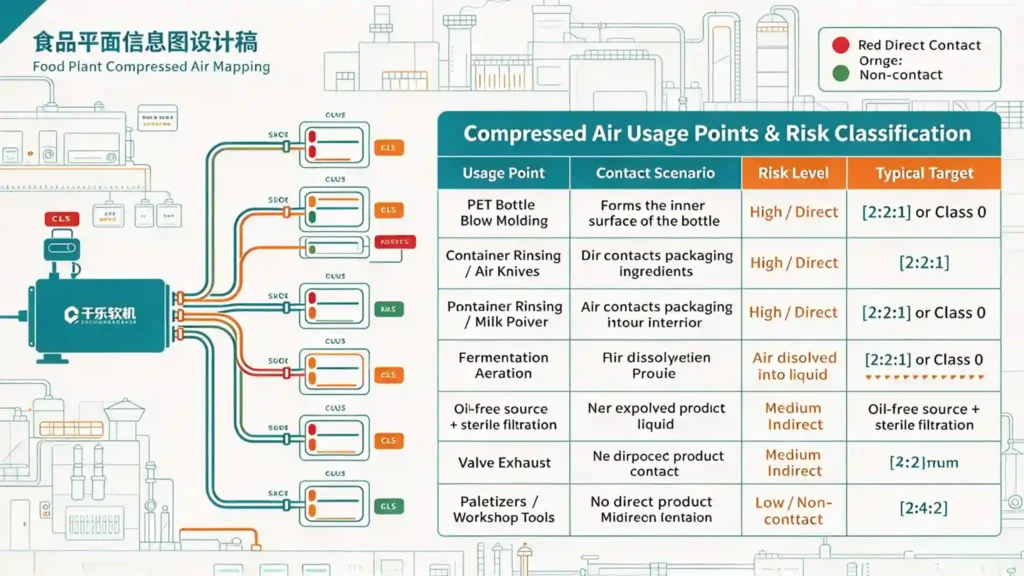
Compressed Air Use Points in Food and Beverage Plants, Mapped to Risk
Start with a walk-through. Every place air comes out of a pipe, note what it touches. Here is a typical map across bakery, dairy, beverage, snack and meat plants.
| Use point | Food-contact scenario | Risk level | Typical target (ISO 8573-1) |
|---|---|---|---|
| PET bottle stretch blow moulding | Air forms the inside of the bottle your drink sits in | High, direct | [2:2:1] or Class 0 oil, sterile filter on blowing air |
| Bottle and can rinsing, air knives, blow-off | Air hits container interiors or exposed product | High, direct | [2:2:1] |
| Pneumatic conveying of flour, sugar, milk powder | Air mixes directly with ingredients | High, direct | [2:2:1] or Class 0 oil |
| Aerating whipped products, mousses, ice cream overrun | Air becomes part of the product | Highest, ingredient | [1:2:1] or better, sterile filtration |
| Wort aeration and yeast propagation in brewing | Air dissolved into the liquid before fermentation | Highest, ingredient | Oil-free source plus sterile filter |
| Nitrogen generator feed for MAP packaging | Feed air becomes the gas in the pack | High, direct | Oil-free feed, plus generator maker spec |
| Optical sorter reject jets | Air blasts nuts, grains, fries off the belt | High, direct | [2:2:1] |
| Cylinders and valves above open product | Exhaust vents near exposed food | Medium, indirect | [2:4:2] minimum, [2:2:1] is safer |
| Palletizers, utility valves, workshop tools | No exposed product nearby | Low, non-contact | [2:4:2] or equipment maker spec |
Two things jump out once you fill in this table for a real plant. First, direct-contact points are usually more numerous than people expect. Second, the high-risk points are often fed from the same header as the palletizer, which means the whole system needs to meet the contact spec anyway.
ISO 8573-1 Class 0 Explained Without the Jargon
ISO 8573-1 grades compressed air on three numbers: solid particles, water and total oil. Oil Class 1 means total oil (aerosol, liquid and vapor combined) at or below 0.01 mg/m³. Oil Class 0 is not a looser grade. It is a stricter limit that the user or supplier defines below the Class 1 value, and a credible Class 0 claim comes with an independent test certificate showing the conditions it was measured under.
For a deeper look at the test method and what to check on a certificate, see our article on ISO 8573-1 Class 0 oil-free air.
Class 0 compressor versus Class 1 air from an oil-injected machine
An oil-injected screw with a coalescing filter and a carbon tower can deliver Class 1 air, and plenty of plants run that way. The catch is how the system behaves when something fails. A saturated separator element, a skipped filter change or a carbon bed past its life can send oil downstream without much warning. With a Class 0 oil-free compressor, there is no oil in the compression chamber to escape in the first place.
There is also a quiet energy angle. Every filter stage costs pressure, and pressure costs power. A train of coalescers and a carbon adsorber can easily add 0.5 bar or more of pressure loss as elements load up, and at roughly 7 percent more energy per extra bar, that adds up over 6,000 running hours a year.
What about food-grade H1 oil?
NSF H1 lubricants are formulated for incidental food contact. That word incidental matters. H1 oil is a safety net for accidental exposure, not a licence to send a steady trace of lubricant into product every shift. If your risk assessment lists H1 oil as the main control for a direct-contact air point, expect your auditor to raise an eyebrow.
Compressed Air in a HACCP-Style Hazard Analysis
Most plants manage compressed air as a prerequisite program with verification testing, and some treat specific high-risk uses as an operational PRP or a CCP. Either way, the hazard analysis looks much the same.
| Hazard | Where it comes from | Control | Verification |
|---|---|---|---|
| Biological | Moist air feeding microbial growth in pipes, unfiltered intake | Desiccant dryer to -40 °C, microbial or sterile filter at point of use | Dew point logging, ISO 8573-7 microbial testing |
| Chemical | Compressor oil aerosol and vapor, hydrocarbons at the intake, cleaning chemical fumes | Class 0 oil-free compressor, careful intake siting, carbon adsorber if needed | ISO 8573-2 and ISO 8573-5 oil testing |
| Physical | Pipe scale, desiccant dust, worn hose fragments, seal debris | Stainless or aluminium piping, post-dryer particulate filter, food-grade hoses | ISO 8573-4 particle testing, filter differential pressure log |
| Backflow and cross-contact | Product, allergen-bearing powder or CIP solution backing into air lines when pressure falls | Check valves at mixing tanks and conveying pickups, air line design above product level | Scheduled inspection of check valves and low points |
That last row catches plants off guard. After a power cut, a mixing tank or conveying line can push product back up the air supply. Then the next time the compressor starts, it blows old product, and maybe allergen, into a different batch. A few check valves are cheap insurance.
Why Water-Lubricated Oil-Free Screws Fit Food Plants
In a water-lubricated screw compressor, purified water replaces oil inside the compression chamber. It seals, cools and lubricates the rotors. The air path never sees oil, so the compressor cannot become the source of an oil event no matter how hard the season runs.
Water injection also keeps compression close to isothermal, so discharge temperature stays low. That eases the load on the dryer, which matters in hot bottling halls and summer beverage peaks. Condensate from an oil-free compressor also carries no compressor oil, so you are not running an oil-water separator just to get it down the drain. Check local discharge rules, since intake air can still bring in some pollutants.
Our CM/B water-lubricated oil-free screw compressor carries TÜV Class 0 certification. The water-lubricated range spans 7.5 to 320 kW, with the fixed-speed CM/B for steady base load and the permanent magnet variable-speed CM/PV for plants where demand jumps between production runs, washdown and changeovers. For PET blowing air, the medium-pressure CM/G series is built for that duty, and for small labs or dedicated point-of-use supply, the CMW oil-free scroll series is worth a look.
One honest note: the water circuit on a water-lubricated machine needs managing. Ask for the water quality spec, treatment method, replacement interval and the materials on water-wetted parts. Treat it like any other hygiene point in your plant and it will look after you.
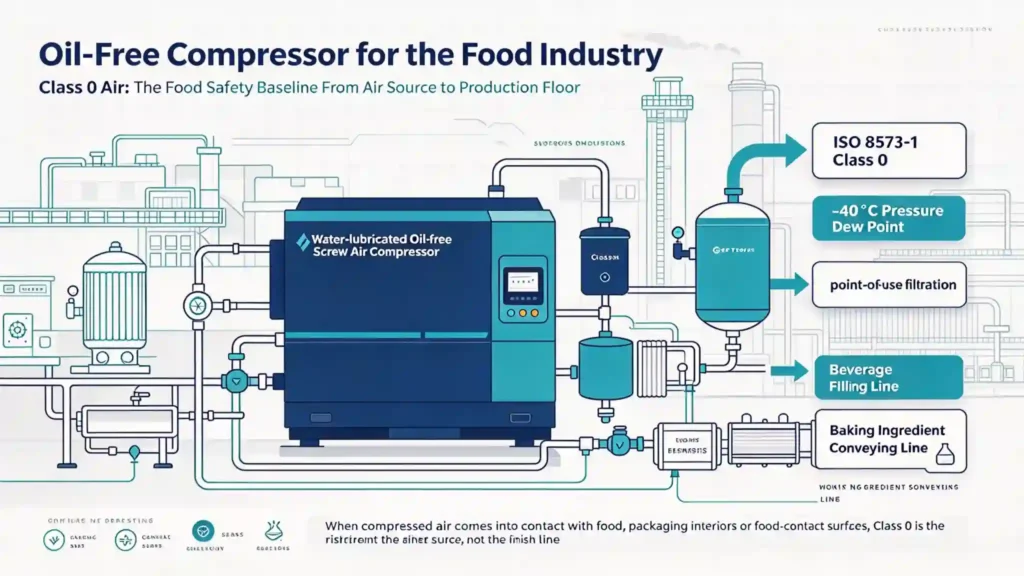
Designing Food Grade Compressed Air From Intake to Nozzle
- Step 1, intake: away from boiler flues, forklift charging areas, truck bays and chemical stores.
- Step 2, Class 0 compressor: sized for base load plus a variable-speed unit for swings, with standby capacity for maintenance.
- Step 3, receiver and separator: removes bulk condensate and buffers peaks from blow-off and air knives.
- Step 4, dryer: desiccant to -40 °C pressure dew point for contact air. Refrigerated dryers struggle if pipes run through blast freezers or cold stores below the dew point.
- Step 5, filtration: particulate filter after the dryer, carbon adsorber if intake conditions call for it.
- Step 6, distribution: stainless or aluminium piping, no galvanized pipe, sampling ports at the far end of each branch.
- Step 7, point of use: food-grade hoses, check valves where backflow is possible, and sterile or microbial filters on ingredient and aseptic air.
Sizing Notes That Are Specific to Food and Beverage
General sizing rules apply: add up connected demand, apply a simultaneity factor, allow for leaks and future growth. Food plants add a few wrinkles of their own.
- Seasonal peaks: beverage plants run flat out in summer, harvest processors run hard for a few months. A variable-speed machine handles the swing better than a big fixed-speed unit loafing through the quiet season.
- Air knives and blow-off: these are often the biggest single consumers and the easiest to trim. Engineered nozzles and timed valves can cut their use sharply.
- Washdown and sanitation shifts: demand can fall to a fraction of production load overnight. Make sure the smallest running machine can idle down without short-cycling.
- PET blowing: high-pressure blowing air is usually a separate system. Size it with the blow moulder maker, then decide whether low-pressure plant air comes from its own compressors or from pressure recovery.
- Nitrogen generation: a nitrogen generator can take a large share of plant air. Include its feed air in the calculation from day one.
Audit Paperwork Worth Keeping Ready
When a BRCGS, SQF or FSSC 22000 auditor walks into the compressor room, these are the records that make the visit short and pleasant:
- Compressed air use point map with contact levels and target air classes.
- Class 0 certificate for the compressor from an independent test body.
- Air quality test reports for particles, water, oil and microbes, with a sampling plan showing where and how often.
- Dew point records and alarm history.
- Filter change logs, including sterile filter integrity tests where used.
- Lubricant list showing H1 grades for any remaining oil-lubricated equipment near product.
- Corrective action records when a test or dew point alarm went out of limits.
Testing frequency comes from your hazard analysis. Many GFSI-certified sites test every direct-contact point at least once a year, test high-risk points more often, and retest after major maintenance or system changes.
Mistakes That Show Up Again and Again
- Feeding air knives from the workshop header as a temporary fix. Temporary has a way of lasting ten years.
- Using a refrigerated dryer, then routing pipe through a freezer, so water condenses right before the product.
- Galvanized pipe that sheds zinc flakes downstream of the dryer.
- Old workshop hoses at food-contact points instead of food-grade hose.
- No check valves on air lines into mixing tanks or conveying pickups.
- Testing only at the compressor outlet, when the auditor wants results from the nozzle.
Buyer Checklist: Oil-Free Compressor for Food Industry Projects
- ☐ Use point map done, each point rated direct, indirect or non-contact
- ☐ Target air class set for each point, [2:2:1] or better for contact air
- ☐ Compressor certified ISO 8573-1 Class 0 by an independent body
- ☐ Demand profile covers seasonal peaks, sanitation shifts and nitrogen generator feed
- ☐ Desiccant dryer at -40 °C wherever pipes pass through cold areas or air contacts product
- ☐ Point-of-use filters and check valves on the drawings
- ☐ Stainless or aluminium piping, sampling ports at branch ends
- ☐ Water quality spec and treatment plan for water-lubricated units
- ☐ Specific power stated at your working pressure, with filter losses included
- ☐ Service intervals, spare parts and support response time agreed
Running a nutraceutical, supplement or pharma line in the same building? The requirements tighten, especially on validation and microbial limits. Our guide to the oil-free compressor for pharmaceutical industry covers GMP air requirements and the validation documents to ask for.
FAQ: Oil-Free Compressors and Class 0 Air in Food Processing
What ISO 8573-1 class is required for food-contact compressed air?
No law sets one number worldwide. The BCAS 102 guideline, which most auditors recognise, recommends [2:2:1] for air in contact with food and [2:4:2] for non-contact air in high-risk areas. Many processors go further and specify Class 0 oil at the compressor.
Do I need a Class 0 compressor if I already use food-grade H1 oil?
H1 oil is designed for incidental contact, not continuous exposure. If air touches product every shift, a Class 0 oil-free compressor removes the oil hazard at the source instead of relying on filters and H1 oil to catch it.
Is compressed air a critical control point in HACCP?
Usually it is managed as a prerequisite program with verification testing. Some plants classify specific uses, such as air used as an ingredient or in aseptic filling, as an operational PRP or a CCP. Your hazard analysis decides.
How often should compressed air be tested in a food plant?
Most GFSI-certified sites test direct-contact points at least annually and high-risk points more frequently, with continuous dew point monitoring and extra tests after maintenance or system changes.
Is a water-lubricated oil-free compressor safe for food processing?
Yes. The water is purified and runs in a managed circuit, and the air then passes through a separator, dryer and filters before reaching product. Follow the water quality spec and include the water circuit in your hygiene and maintenance schedule.
Does an oil-free compressor cost more to run?
Purchase price is usually higher than an oil-injected unit of the same size. Running cost often evens out because you skip oil changes, oil-water separators and heavy filter trains, and you lose less pressure through filters. Compare total cost over the life of the machine, not the invoice.
What information do you need to quote a food-grade Class 0 system?
Your use point list, total flow, working pressure, target air class and dew point, product type, voltage and frequency, ambient conditions, and any seasonal or shift patterns in demand.
Ready to Take Oil Out of the Equation?
Send us your use point list, flow, working pressure and target air class. Our engineers will size a Class 0 compressor, dryer and filtration train for your plant and list the certificates your food safety team will want on file.
Only have a machine list and a floor plan? That is enough to get started.