
Oil-Free Compressor for Pharmaceutical Manufacturing: What GMP Actually Expects From Your Air
If you work in a pharma plant, you already know compressed air sits in a funny spot. Engineering treats it as a utility. QA treats it as a possible contaminant. The auditor treats it as a great place to start asking questions. Honestly, all three are right.
This guide is written for the people who have to live with that tension: plant engineers, validation leads and buyers who need an oil free compressor for pharmaceutical manufacturing that holds up in a risk assessment, not just on a brochure. We cover where air actually touches your process, which contaminants matter, what documents to ask for, how to size the system, and a checklist you can bring to your next supplier call.
The short answer
For compressed air that contacts product, primary packaging or product-contact surfaces, most pharmaceutical plants specify ISO 8573-1 Class 1 or Class 0 for oil, a pressure dew point of -40 °C or lower, Class 1 or 2 for particles, and a sterilizing-grade filter at the point of use for aseptic steps.
A Class 0 oil-free compressor removes the machine itself as a source of oil. It does not, on its own, make your air GMP compliant. Compliance comes from the whole chain: intake, compressor, dryer, filtration, clean distribution piping, point-of-use testing and the paperwork that proves all of it.
Why Compressed Air Is a GMP Topic in the First Place
No GMP regulation tells you which compressor to buy. What the rules do say is that anything contacting your product must not add contamination. In the US, 21 CFR 211.65 states that substances needed to run equipment, such as lubricants and coolants, must not contact components, containers or drug product in a way that alters quality. Compressor oil carried downstream in the air stream is exactly that kind of substance.
In Europe, the revised EU GMP Annex 1 (2022) expects gases that contact product or primary surfaces to be of appropriate chemical, particulate and microbial quality, with sterile filtration at the point of use for aseptic processing and routine filter integrity testing. PIC/S members follow the same logic. So when an inspector asks how you know your compressed air is clean, the answer needs to be data and documents, not a shrug and a spec sheet from 2014.
That is where pharmaceutical compressed air quality becomes a design decision, a validation task and a maintenance program all at once.
Where Compressed Air Touches a Pharmaceutical Process
Before talking hardware, map your use points. The contact level at each point drives the air quality target, and that target drives everything downstream. Here is a typical map for a solid-dose or sterile facility. Your own risk assessment has the final say.
| Use point | Contact level | Main risk | Typical target (ISO 8573-1) |
|---|---|---|---|
| Tablet coating spray guns (atomizing and pattern air) | Direct | Oil film, particles, microbes on the tablet surface | [1:2:1] or Class 0 oil, point-of-use filtration |
| Fluid bed granulation and drying | Direct | Moisture pickup, particles | [1:2:1], dew point -40 °C |
| Pneumatic conveying of API and excipients | Direct | Oil and particles mixed into powder | [1:2:1] or Class 0 oil |
| Blow-fill-seal and aseptic filling | Direct, sterile | Microbial ingress, oil | [1:2:1] or better, plus integrity-tested 0.2 µm sterilizing filter |
| Vial and bottle blow-off, line purging | Direct to primary packaging | Particles, oil residue inside containers | [1:2:1] |
| Bioreactor or fermenter aeration | Direct, sterile | Microbial contamination of the culture | Oil-free source plus sterile filtration |
| Valve actuators and cylinders inside cleanrooms | Indirect (exhaust vents into the room) | Oil mist and particles released into classified air | [2:4:2] minimum, many sites run the tighter spec site-wide |
| General instrument air outside classified areas | Non-contact | Moisture, valve sticking | [2:4:2] or per equipment maker |
Quick note on the notation: ISO 8573-1 [1:2:1] means particle Class 1, water Class 2 (pressure dew point -40 °C or lower) and oil Class 1 (total oil of 0.01 mg/m³ or less). Class 0 for oil is not a looser rating, it is a stricter limit that the user or supplier specifies below the Class 1 figure.
Also worth pointing out: an actuator inside a Grade C room is technically non-contact, but every stroke dumps its exhaust air into that room. Non-contact does not mean no risk. It just means a different risk.
The Four Contaminants Auditors Ask About
1. Oil: aerosol, liquid and vapor
Oil shows up in three forms. Liquid and aerosol oil come mostly from oil-injected compressors. Oil vapor can come from the compressor, but it also comes from the air you suck in. Put the intake near a loading dock with idling trucks or downwind of a diesel generator, and even a perfectly oil-free machine will pass hydrocarbons downstream. Your risk assessment should cover intake location, not just compressor type.
An oil-injected compressor with coalescing and carbon filters can hit Class 1 on paper when everything is brand new. The real question is what the air looks like on day 300, after a filter change slipped because the maintenance team was short-handed that month. That is a tough conversation to have with QA, and a big reason plants move to oil-free.
2. Water
Liquid water in piping is a microbial growth medium, full stop. A pressure dew point of -40 °C keeps relative humidity inside the pipe low enough that bacteria and mould struggle to grow. A refrigerated dryer at +3 °C is fine for general plant air, but it rarely passes a risk assessment for product contact air in pharma.
3. Particles
Particles come from wear inside the compressor, desiccant dust from the dryer, rusted carbon steel pipe and gasket debris. This is why a particulate filter after the desiccant dryer and stainless distribution downstream are standard practice, not gold plating.
4. Microorganisms
ISO 8573-7 gives the test method for viable microbial content. Limits are usually aligned with the cleanroom grade where the air is released, so air discharged into a Grade A zone is held to Grade A expectations. A sterilizing-grade 0.2 µm filter at the point of use is the final barrier, and it needs its own integrity testing records.
Oil-Free Compressor Technologies for Pharma: An Honest Comparison
There are several ways to get oil-free compressed air. Each works. Each has trade-offs that matter more in a GMP plant than in a general factory.
| Technology | Oil in compression chamber | Discharge temperature | Where it fits | Watch-outs |
|---|---|---|---|---|
| Water-lubricated oil-free screw | None, purified water seals, cools and lubricates | Low, close to isothermal compression | Central plant air for product contact, single-stage simplicity | Water treatment and water quality monitoring are part of the job |
| Dry two-stage oil-free screw | None, gearbox oil sealed off from air path | High in each stage before intercooling | Large central plants | More complex, rotor coating wear, higher cost at small sizes |
| Oil-free scroll | None | Moderate | QC labs, pilot plants, dedicated point-of-use supply | Limited flow per unit, multiple units for larger demand |
| Oil-injected screw plus filtration | Yes | Moderate | Non-contact utility air | Air quality depends on filter upkeep, hard to defend for product contact |
Why Water-Lubricated Screw Compressors Suit Pharmaceutical Plants
In a water-lubricated machine, purified water replaces oil inside the compression chamber. The water seals the rotor clearances, carries away the heat of compression and lubricates the rotors. There is no oil in the air path at any point, so the compressor cannot pass oil downstream even if something upstream goes sideways.
The water also keeps compression close to isothermal, so discharge temperature stays low. That takes load off the aftercooler and the dryer, and it avoids the high-temperature stages found in dry oil-free designs. For a plant engineer, single-stage compression with fewer hot components usually means a simpler maintenance plan.
Our CM/B water-lubricated oil-free screw compressor is built on this principle and carries TÜV Class 0 certification for oil content. The water-lubricated range covers 7.5 to 320 kW, with the fixed-speed CM/B for stable base load and the permanent magnet variable-speed CM/PV for plants where demand swings between shifts, batches and cleaning cycles. For QC labs or a small dedicated clean-air loop, the CMW oil-free scroll series is often the better fit.
Fair warning, because nobody likes surprises after commissioning: a water-lubricated compressor needs its water circuit managed properly. Ask any supplier for the water quality spec, the treatment method, the replacement interval and the materials used on water-wetted parts. If those answers are vague, keep asking.
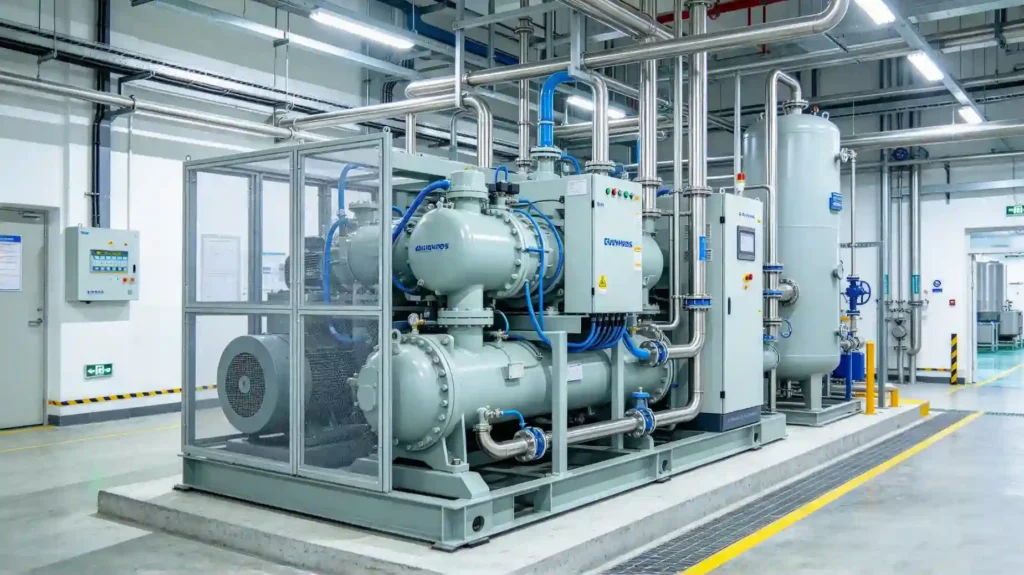
Water-lubricated oil-free screw compressor feeding a GMP compressed air system.
Building a GMP-Ready Compressed Air System, From Intake to Point of Use
A Class 0 compressor is one link. Here is the full chain most validated systems follow, in flow order.
- Step 1, intake: clean location away from exhausts, boilers and loading docks, with a suitable pre-filter.
- Step 2, compressor: Class 0 oil-free, with redundancy so one unit can be serviced without stopping production.
- Step 3, wet receiver and separator: removes bulk condensate and smooths demand peaks.
- Step 4, desiccant dryer: heatless or heated desiccant to -40 °C pressure dew point, with a calibrated dew point sensor and alarm.
- Step 5, filtration: particulate filter after the dryer to catch desiccant dust, plus activated carbon if your intake risk assessment calls for vapor control.
- Step 6, dry receiver: buffer volume close to the main demand.
- Step 7, distribution: stainless steel (304 or 316L) downstream of treatment, loop layout where possible, and sampling ports at representative and worst-case points.
- Step 8, point of use: 0.2 µm sterilizing-grade filters for aseptic uses, integrity tested on a defined schedule, with housings that can be sterilized where required.
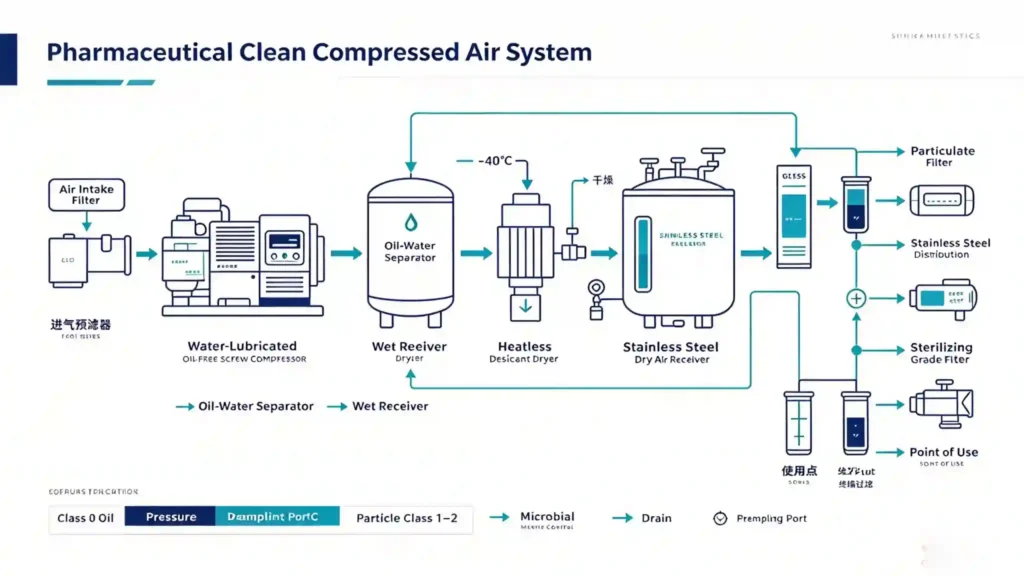
Typical pharmaceutical clean dry air train: compressor, treatment, distribution and point-of-use protection.
Validation Documents to Request Before You Place the Order
Your validation team will build IQ, OQ and PQ protocols around this system. The supplier can make that easy or make it a gong show. Ask for these up front and put them in the purchase specification.
- ISO 8573-1 Class 0 certificate for the compressor, issued by an independent body, with the test conditions stated.
- General arrangement drawings, P&ID and electrical schematics.
- Material certificates for wetted and air-path components.
- Dryer and filter data sheets, with filter performance tested to ISO 12500.
- Calibration certificates for dew point, pressure and temperature instruments.
- FAT and SAT protocols, plus test records.
- IQ and OQ support documents or templates.
- Maintenance manual, recommended spare parts list and service intervals.
- For water-lubricated units: water quality specification and water treatment procedure.
- Sterile filter validation data (bacterial retention, integrity test values) from the filter maker.
During PQ, air is sampled at defined points and tested for particles (ISO 8573-4), humidity (ISO 8573-3), oil aerosol (ISO 8573-2), oil vapor (ISO 8573-5) and microbes (ISO 8573-7). Routine testing frequency comes from your risk assessment. Many sites test critical product-contact points quarterly or semi-annually and lower-risk points once a year.
Sizing an Oil-Free Compressor for Pharmaceutical Duty
Oversizing is the classic mistake. A big fixed-speed machine running half loaded all week burns power and cycles more than it should. Here is a simple worked example for a mid-size solid-dose plant running at 7 bar(g).
| Demand item | Flow (m³/min FAD) |
|---|---|
| 2 coating pans at 1.2 each | 2.4 |
| Fluid bed dryer | 2.0 |
| Blister and cartoning lines | 1.8 |
| Pneumatic conveying | 2.5 |
| Actuators and instrument air | 1.2 |
| Connected total | 9.9 |
| After 0.85 simultaneity factor | 8.4 |
| Plus 10 percent leakage allowance | 9.2 |
| Plus 20 percent future expansion | about 11.1 |
At 7 bar, 11 m³/min lands roughly in the 75 kW class for an oil-free screw, but the final number must come from the actual performance curve at your pressure, altitude and ambient temperature. One common layout is two machines that can each carry the full load: a fixed-speed CM/B as base load and a variable-speed CM/PV as trim. Either one can run the plant during service, which keeps both production and QA happy.
Two more rules of thumb. First, every extra 1 bar of discharge pressure costs roughly 7 percent more energy, so do not run 8.5 bar because one old machine once needed it. Second, fix leaks before you buy capacity. Air leaks in older plants commonly eat 20 percent or more of compressor output.
Mistakes We Keep Seeing on Pharma Compressed Air Projects
- Assuming a Class 0 compressor means Class 0 air at the point of use. It certifies the compressor, not your piping, dryer or intake.
- Running carbon steel pipe downstream of the dryer, then chasing rust particles for years.
- Forgetting sampling ports, so every air quality test turns into a shutdown and a pipefitter call.
- No redundancy. One compressor fault and the whole coating suite stops.
- Putting the intake next to the generator exhaust or the truck bay.
- Skipping water treatment checks on a water-lubricated machine because it looked set-and-forget during FAT.
Procurement Checklist: Pharmaceutical Oil-Free Compressor
Print this, bring it to the supplier meeting, and tick the boxes.
- ☐ Use point map completed, with contact level and target ISO 8573-1 class for each point
- ☐ Compressor certified ISO 8573-1 Class 0 by an independent body
- ☐ Flow, pressure and duty profile confirmed, including simultaneity, leakage and expansion
- ☐ Redundancy defined (N+1 or two full-capacity units)
- ☐ Dryer rated for -40 °C pressure dew point or lower, with dew point monitoring and alarm
- ☐ Filtration train specified to ISO 12500, including point-of-use sterile filters where needed
- ☐ Stainless distribution and sampling ports on the drawings
- ☐ Validation document package listed in the purchase order
- ☐ FAT and SAT scope agreed
- ☐ Water quality spec and treatment plan (water-lubricated units)
- ☐ Service intervals, spare parts and local support confirmed
- ☐ Energy figures stated as specific power at your working pressure
If part of your plant also handles food-grade or nutraceutical lines, the same logic applies with a slightly different regulatory lens. We cover that side in our guide to choosing a food grade oil-free compressor and what ISO 8573-1 Class 0 really means on a production floor.
FAQ: Oil-Free Compressors in Pharmaceutical Manufacturing
Is an oil-free compressor mandatory under GMP?
No regulation names a compressor type. GMP requires that product-contact air does not add contamination, and 21 CFR 211.65 specifically says lubricants must not contact the product in a way that affects quality. An oil-free compressor is the simplest way to remove oil from the risk assessment, which is why most pharma plants choose one for product-contact air.
What is the difference between ISO 8573-1 Class 0 and Class 1 for oil?
Class 1 allows total oil (aerosol, liquid and vapor) up to 0.01 mg/m³. Class 0 is a stricter limit agreed between the user and the supplier, set below Class 1. When a compressor claims Class 0, ask for the certificate and the test conditions behind it.
What dew point does pharmaceutical compressed air need?
For product-contact air, -40 °C pressure dew point (ISO 8573-1 water Class 2) is the common baseline. Some sites go to -70 °C for sensitive products or piping routed through cold areas. General utility air can often run at a refrigerated +3 °C dew point.
How often should compressed air be tested in a pharma plant?
Your risk assessment sets the schedule. Many plants test critical product-contact points quarterly or semi-annually and lower-risk points annually, with dew point monitored continuously and extra testing after any major change or maintenance.
Do water-lubricated compressors create a microbial risk?
The water circuit is treated and managed, and the air then passes through a separator, a desiccant dryer and point-of-use filtration before reaching the process. With the water quality spec followed and dew point held at -40 °C, the microbial risk in the air stream is controlled. Include the water circuit in your maintenance SOPs so it is not forgotten.
Can one compressed air system serve both product-contact and utility air?
Yes, if the entire header meets the stricter product-contact spec. Some plants split the system and treat only the critical branch to the higher standard. A single high-spec system costs more in treatment but is simpler to validate and maintain.
What information do you need to quote a pharmaceutical clean-air system?
Use point list with contact levels, total flow, working pressure, target dew point and air class, cleanroom grades, site voltage and frequency, altitude, ambient conditions, redundancy needs and the validation documents you expect.
Planning a GMP Compressed Air Upgrade?
Send us your use point list, flow, working pressure, dew point target and cleanroom grades. Our engineers will come back with a sized Class 0 system, treatment train and the validation document list, so your QA team knows what they are getting before the PO goes out.
No data sheet yet? A floor plan and a rough list of machines is enough to start.