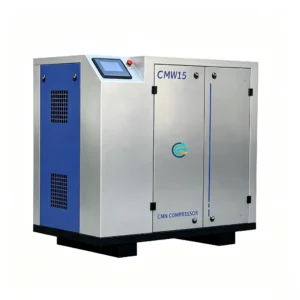
Description
CMW Series Oil-Free Scroll Air Compressor — 0.8 MPa / 116 PSI
2.2 kW – 22 kW · 255 – 2490 L/min (9 – 88 cfm) · 49 – 63 dB(A) · ISO 8573-1 Class 0 · 1/2″ – 1″ outlet
The CMW series at 0.8 MPa (116 PSI) is the workhorse configuration for applications where clean, quiet air is the primary requirement and 0.8 MPa supply pressure covers every downstream use. Scroll compression is mechanically different from screw or piston designs: a fixed scroll and an orbiting scroll create progressively smaller compression pockets as gas moves toward the centre. There are no valves, no reciprocating motion, and critically — no oil in the compression chamber. The result is genuinely oil-free air from a machine that runs at 49–63 dB(A) depending on size, without the pulsation and vibration that makes piston compressors unsuitable for sensitive environments.
The 0.8 MPa pressure rating covers the full range of standard industrial and laboratory pneumatic applications: most bench-top instruments operate at 0.4–0.6 MPa, dental handpieces at 0.55–0.65 MPa, and general pneumatic tools at 0.6–0.8 MPa. If your downstream pressure requirement does not exceed 0.8 MPa (116 PSI), this series gives you the lowest noise floor and the simplest system — no pressure regulation stage needed between the compressor and the network.
Eight models span from the compact CMW2.2-0.8 (2.2 kW, 255 L/min, 132 kg) to the CMW22-0.8 (3.7×6 = 22.2 kW, 2490 L/min, 650 kg). Multi-head configurations (e.g. 3.7×2, 3.7×3) use independently driven scroll heads on a common manifold — if one head requires maintenance, the others continue running. That built-in partial redundancy is why scroll compressors are standard in hospital medical air systems where unplanned downtime is not acceptable.
CMW Series Oil-Free Scroll Air Compressor Technical Parameters — Full Product Line
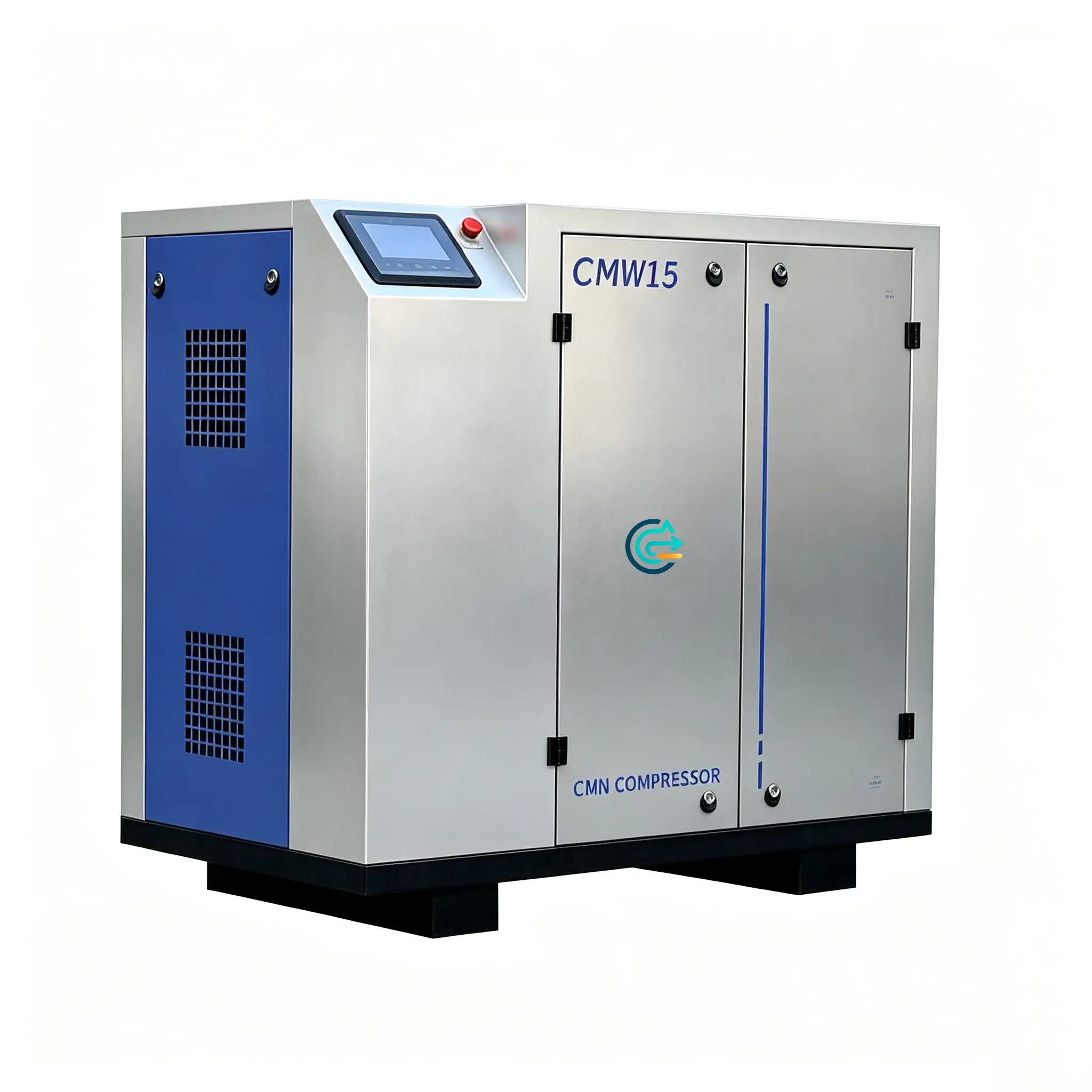
CMW series complete parameter table · 0.8 / 1.0 / 1.2 MPa configurations
0.8 MPa Series — Key Performance Figures
CMW Series 0.8 MPa — Complete Model Specifications
Pressure range adjustable 0.2–0.8 MPa (29–116 PSI). Gas production measured at 0.8 MPa. All noise figures ±3 dB(A). Dimensions L×W×H in mm.
| Model | Power kW / HP |
Pressure MPa / PSI |
Output L/min |
Output cfm |
Noise dB(A) |
Air outlet inch |
Weight kg |
Dimension L×W×H mm |
|---|---|---|---|---|---|---|---|---|
| CMW2.2-0.8 | 2.2 / 3 | 0.2–0.8 / 29–116 | 255 | 9 | 49±3 | 1/2″ | 132 | 665×630×940 |
| CMW3.7-0.8 | 3.7 / 5 | 0.2–0.8 / 29–116 | 415 | 15 | 52±3 | 1/2″ | 150 | 660×665×990 |
| CMW4.4-0.8 | 2.2×2 / 6 | 0.2–0.8 / 29–116 | 510 | 18 | 52±3 | 1/2″ | 150 | 800×670×1190 |
| CMW7.4-0.8 | 3.7×2 / 10 | 0.2–0.8 / 29–116 | 830 | 29 | 55±3 | 1″ | 185 | 880×670×1190 |
| CMW11-0.8 | 3.7×3 / 15 | 0.2–0.8 / 29–116 | 1245 | 44 | 58±3 | 1″ | 300 | 1400×800×1280 |
| CMW15-0.8 | 3.7×4 / 20 | 0.2–0.8 / 29–116 | 1660 | 59 | 61±3 | 1″ | 350 | 1400×800×1280 |
| CMW18.5-0.8 | 3.7×5 / 25 | 0.2–0.8 / 29–116 | 2075 | 73 | 63±3 | 1″ | 600 | 1400×800×1870 |
| CMW22-0.8 | 3.7×6 / 30 | 0.2–0.8 / 29–116 | 2490 | 88 | 63±3 | 1″ | 650 | 1400×800×1870 |
Scroll Compression — Why It Produces Quieter, Cleaner Air Than Piston or Screw Designs
The fundamental noise problem with piston compressors is the reciprocating motion: each stroke creates a pressure pulse, and at audible frequencies those pulses are exactly what you hear as the characteristic “chatter.” Scroll compressors have no reciprocating components. The orbiting scroll moves in a continuous circular path — there is no reversal of direction, no valve opening/closing, and no pulsation. The compression process is smooth and continuous, which is why the CMW2.2-0.8 measures 49±3 dB(A) — quieter than a typical office environment.
The oil-free claim in a scroll compressor is simpler than in a screw compressor: there are no rotor clearances to seal with a fluid medium. The scroll geometry itself creates the compression seal. The tip seals (PTFE-based) ride against the scroll surfaces to maintain compression efficiency without any lubricant entering the gas stream. The bearings are in a separate sealed housing with their own grease charge — this grease never contacts the compressed air path.
Multi-head units (CMW4.4-0.8 through CMW22-0.8) mount multiple independently driven scroll heads on a common base and discharge manifold. Each head has its own motor, its own tip seals, and its own service intervals. If one head fails or needs tip seal replacement, the others continue operating. For a medical gas system serving an operating theatre suite, this architecture is not optional — it is the minimum acceptable reliability standard.
Where the CMW 0.8 MPa Series Is Actually Used

The oil-free scroll air compressor for medical and dental use is the de facto standard in hospital and clinic installations. ISO 7396-1 (medical gas piped systems) and HTM 02-01 (UK health technical memorandum) both require verified oil-free compressed air for patient-contact applications. The CMW2.2-0.8 (49±3 dB) and CMW3.7-0.8 (52±3 dB) are routinely installed in dental surgeries and GP consulting rooms — noise is not an issue for staff or patients. Multi-head models (CMW7.4-0.8 upward) handle hospital wing or day-surgery centre demand with built-in head redundancy.
Gas chromatographs, mass spectrometers, LC-MS systems, and TOC analysers all require carrier gas or nebuliser air that is both oil-free and pulse-free. A piston compressor’s pressure pulsation can introduce baseline noise in chromatographic detectors. Scroll compressors deliver the smooth, steady pressure profile analytical instruments require. The quiet oil-free scroll compressor 0.8 MPa for laboratory applications starts with the CMW2.2-0.8 for a single instrument and scales to CMW7.4-0.8 for a multi-instrument laboratory suite.
Wave solder flux removal, SMT component placement, and conformal coating spray all require clean, dry, oil-free air at 0.4–0.7 MPa. Oil contamination on PCB surfaces causes solder bridging, flux adhesion failure, and coating delamination. The CMW series delivers Class 0 air without the activated-carbon filtration that oil-injected compressors require — fewer consumables, fewer maintenance points, lower lifetime cost.
EU Regulation 1935/2004, FDA 21 CFR, and BRC Global Standard all require that compressed air contacting food or packaging is demonstrably oil-free. The CMW scroll series satisfies this requirement at source — the discharge air is Class 0 by design. For small-to-medium food producers who cannot justify the footprint and cost of a full oil-free screw system, the CMW11-0.8 through CMW22-0.8 range covers central air supply for an SME food plant.

Multi-Head Configuration — Reliability Built In, Not Added On
The CMW model numbers encode the configuration directly: CMW4.4-0.8 = 2.2 kW × 2 heads; CMW7.4-0.8 = 3.7 kW × 2 heads; CMW11-0.8 = 3.7 kW × 3 heads, and so on up to CMW22-0.8 = 3.7 kW × 6 heads. Each head is a complete, independently controlled scroll compressor with its own motor, motor protection, pressure switch, and check valve. The heads share only the discharge manifold and the air receiver (if fitted).
This architecture has two operational consequences. First, maintenance can be staggered: tip seal replacement (the primary wear item in an oil-free scroll) is done head by head, with the remaining heads holding system pressure during the work. A six-head CMW22-0.8 loses at most 1/6 of capacity during a head service — it does not go offline entirely. Second, load balancing: a PLC-based sequencer rotates which head runs as the lead unit, distributing running hours evenly across all heads and extending the interval between tip seal changes.
Tip seal life in an oil-free scroll is typically 8,000–12,000 hours depending on inlet air quality and operating temperature. At 6,000 operating hours per year, that means roughly 18 months between tip seal changes per head. Inlet air filtration (minimum G4 + F7 or equivalent upstream filtration) is the single biggest determinant of tip seal longevity — dirty inlet air accelerates tip seal wear faster than any other factor.
Maintenance Schedule — CMW 0.8 MPa Series
| Item | Interval | Notes |
|---|---|---|
| Inlet air filter | Every 500 h | Replace more frequently in dusty environments — the single biggest driver of tip seal life |
| Tip seals (PTFE) | 8,000–12,000 h per head | Replace one head at a time; remaining heads maintain pressure |
| Motor bearing grease | Every 4,000 h | Lithium-complex grease; volume per instruction manual |
| Discharge check valves | Inspect at 8,000 h | Replace if seat shows wear or leakage at head startup |
| General inspection | Annually | Fastener torque, vibration isolators, pressure switch calibration |
Selecting the Right Model — Flow Demand vs Head Count
- CMW2.2-0.8 (255 L/min / 9 cfm): Single dental surgery, small laboratory with 1–2 analytical instruments, precision painting booth
- CMW3.7-0.8 (415 L/min / 15 cfm): Dental clinic with 2–3 treatment chairs, R&D lab, small food packaging line
- CMW4.4-0.8 (510 L/min / 18 cfm): 2-head system — first step into redundant architecture; suitable for any critical-care dental or medical installation
- CMW7.4-0.8 (830 L/min / 29 cfm): Hospital out-patient department, electronics SMT line, medium laboratory building
- CMW11-0.8 (1245 L/min / 44 cfm): Small hospital ward block, food production hall (SME scale), multi-line PCB assembly
- CMW15-0.8 (1660 L/min / 59 cfm): Mid-size hospital, large dental chain central supply, food processing facility
- CMW18.5-0.8 (2075 L/min / 73 cfm): Large hospital or clinic campus, pharmaceutical packaging building
- CMW22-0.8 (2490 L/min / 88 cfm): Hospital central plant, large food manufacturer, multi-building medical campus
Technical Questions of Oil-Free Scroll Air Compressor
Select Your CMW 0.8 MPa Configuration
Tell us your required flow (L/min or cfm), installation environment (noise sensitivity, ventilation), and whether medical-grade documentation is needed — we’ll confirm the right model and options within one business day.