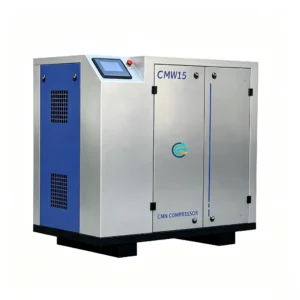
Description
CMW Series Oil-Free Scroll Compressor — 1.0 MPa / 145 PSI
2.2 kW – 27 kW · 215 – 2460 L/min (8 – 87 cfm) · 49 – 63 dB(A) · ISO 8573-1 Class 0 · 1/2″ – 1″ outlet
The CMW series at 1.0 MPa (145 PSI) covers the pressure band that most pharmaceutical manufacturing, cleanroom, and precision-instrument applications actually require. Where the 0.8 MPa variant is optimised for medical gas and dental applications, the 1.0 MPa configuration provides the headroom for processes that need sustained pressure at the tool or instrument — accounting for system pressure drop across distribution pipework, filters, and dryers without falling below the minimum working pressure at the point of use.
Eight models span from the CMW2.2-1.0 (2.2 kW, 215 L/min) to the CMW27-1.0 (4.5×6 = 27 kW, 2460 L/min). Note the architecture shift compared with the 0.8 MPa series: from CMW4.5-1.0 onward, the individual head power is 4.5 kW rather than 3.7 kW, reflecting the higher compression work required at 1.0 MPa. The CMW4.4-1.0 is the only dual-head 0.8 MPa crossover model using 2.2 kW heads.
For a process engineer specifying instrument air for a pharmaceutical manufacturing building: the typical demand is 0.6–0.8 MPa at the instrument, the distribution system pressure drop is 0.05–0.15 MPa depending on pipework age and layout, and the dryer/filter train adds another 0.05–0.10 MPa. Supply pressure of 1.0 MPa gives you that margin without pushing into unnecessary high-pressure territory. That is the practical reason this pressure tier exists — not because 1.0 MPa compressors are inherently superior to 0.8 MPa, but because real distribution systems have real losses.
CMW Series Technical Parameters — Full Product Line
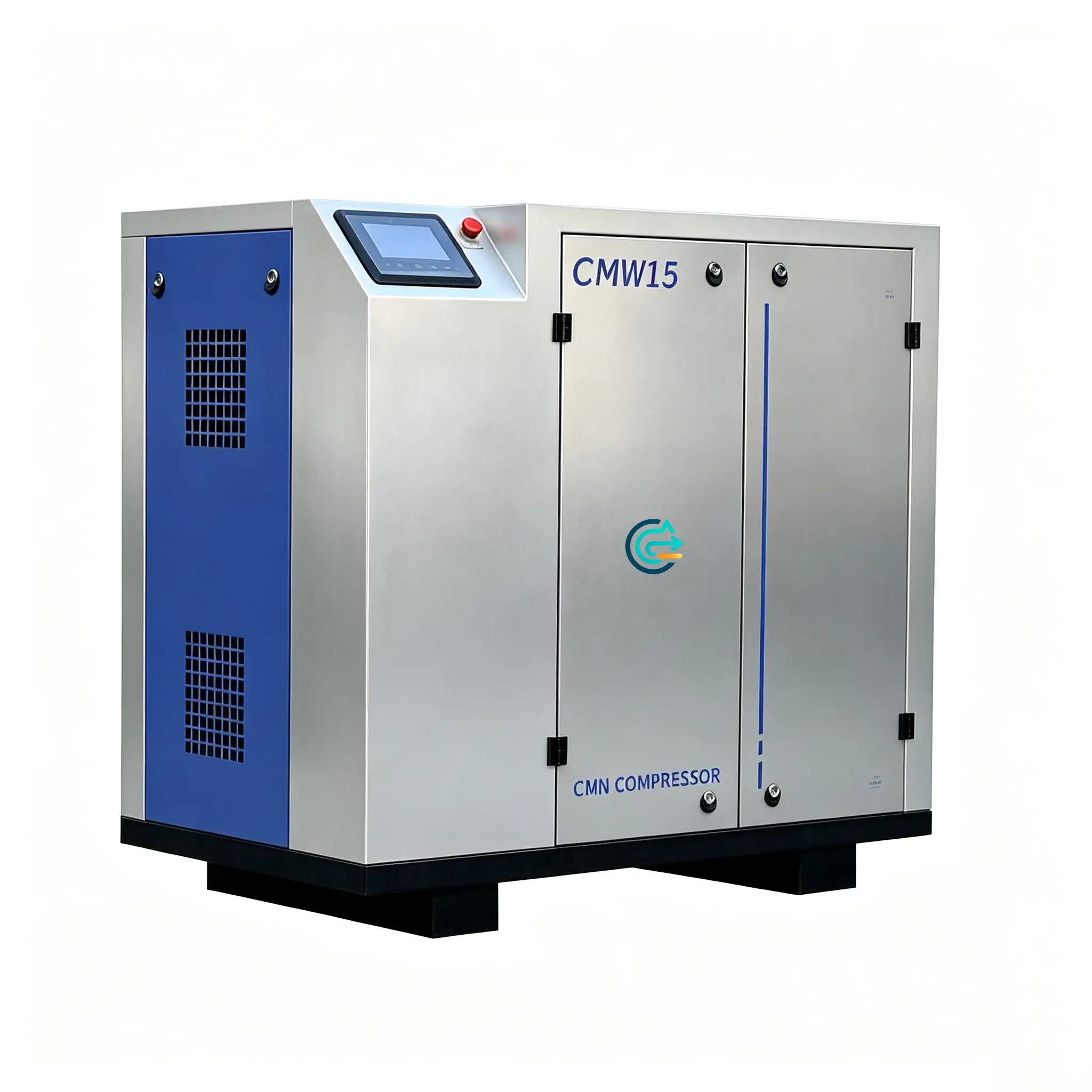
CMW series complete parameter table · 0.8 / 1.0 / 1.2 MPa configurations
1.0 MPa Series — Key Performance Data
CMW Series 1.0 MPa — Complete Model Specifications
Pressure adjustable 0.2–1.0 MPa (29–145 PSI). Gas production at rated 1.0 MPa. Noise ±3 dB(A). L×W×H in mm.
| Model | Power kW / HP |
Pressure MPa / PSI |
Output L/min |
Output cfm |
Noise dB(A) |
Air outlet inch |
Weight kg |
Dimension L×W×H mm |
|---|---|---|---|---|---|---|---|---|
| CMW2.2-1.0 | 2.2 / 3 | 0.2–1.0 / 29–145 | 215 | 8 | 49±3 | 1/2″ | 132 | 665×630×940 |
| CMW4.5-1.0 | 4.5 / 6 | 0.2–1.0 / 29–145 | 410 | 14 | 52±3 | 1/2″ | 150 | 660×665×990 |
| CMW4.4-1.0 | 2.2×2 / 6 | 0.2–1.0 / 29–145 | 430 | 15 | 52±3 | 1/2″ | 150 | 800×670×1190 |
| CMW9-1.0 | 4.5×2 / 12 | 0.2–1.0 / 29–145 | 820 | 29 | 58±3 | 1″ | 185 | 880×670×1190 |
| CMW13.5-1.0 | 4.5×3 / 18 | 0.2–1.0 / 29–145 | 1230 | 43 | 61±3 | 1″ | 300 | 1400×800×1280 |
| CMW18-1.0 | 4.5×4 / 25 | 0.2–1.0 / 29–145 | 1640 | 58 | 61±3 | 1″ | 350 | 1400×800×1280 |
| CMW22.5-1.0 | 4.5×5 / 30 | 0.2–1.0 / 29–145 | 2050 | 72 | 63±3 | 1″ | 600 | 1400×800×1870 |
| CMW27-1.0 | 4.5×6 / 36 | 0.2–1.0 / 29–145 | 2460 | 87 | 63±3 | 1″ | 650 | 1400×800×1870 |
Why 1.0 MPa Rather Than 0.8 MPa — The Distribution Pressure Loss Argument
In a properly designed compressed air system, the compressor discharge pressure is set at a level that delivers the minimum required working pressure at the furthest or most demanding point of use — accounting for all losses between the compressor and that point. Those losses include: pipe friction (proportional to flow velocity and pipe length), fittings and bends, filter element differential (typically 0.03–0.05 MPa when clean, up to 0.10 MPa when due for change), dryer pressure drop (0.02–0.05 MPa for refrigerant type), pressure regulator set-point margin, and any elevation difference in the distribution system.
In a pharmaceutical manufacturing building with 50–100 metres of 1″ distribution pipework and a typical filter/dryer train, total system pressure drop at full flow is commonly 0.12–0.20 MPa. If your instruments require 0.7 MPa at the instrument, you need to supply 0.82–0.90 MPa at the compressor. That puts you firmly in 1.0 MPa territory with the pressure headroom to absorb filter differential increase between service intervals.
Selecting a 0.8 MPa compressor for a 0.7 MPa process requirement in a building with average distribution losses is a common specification mistake — it leaves no margin for filter loading and creates pressure at the instrument that dips below the minimum during peak demand. The 1.0 MPa CMW series is the correct specification for that scenario.
Industries Where the 1.0 MPa / 145 PSI Rating Is Standard Specification

EU GMP Annex 1 (2022 revision) specifies compressed air used in sterile manufacturing as a utility that requires documented quality testing, including oil content. ISO 8573-1 Class 0 from the CMW series eliminates the need for downstream oil-content monitoring and simplifies the quality assurance dossier. The oil-free scroll compressor 145 PSI for pharmaceutical manufacturing at 1.0 MPa covers blister packaging lines, API synthesis vessel purging, lyophiliser pneumatics, and isolator pressure maintenance — all at a supply pressure that builds in distribution loss margin.
University and industrial R&D laboratories specify 1.0 MPa instrument air because it accommodates a wider range of instruments without separate pressure regulation at each bench. LC-MS, ICP-MS, FTIR, and automated synthesis platforms all have different pneumatic requirements — a single 1.0 MPa oil-free supply with bench-top regulators at each instrument is the simplest, most flexible architecture. The CMW9-1.0 (820 L/min, 4.5×2 heads) is a common choice for a 10–15 instrument analytical laboratory.
Cleanroom process air for sub-cleanroom applications (ISO Class 6–8) typically specifies 0.6–0.8 MPa at the tool, with 1.0 MPa supply to accommodate distribution. The CMW’s inherently pulse-free output is well matched to pneumatic actuators in cleanroom automation, where pressure pulsation causes micro-vibration that affects yield-sensitive processes. Class 0 oil-free air prevents photoresist contamination and eliminates carbon filter maintenance from the cleanroom utility schedule.
Larger food plants with extended distribution networks — production halls over 100 m long — benefit from 1.0 MPa supply to maintain adequate pressure at the far end of the network without over-sizing pipework. CO₂ injection systems, bottle capping, and portion-control pneumatics all operate comfortably at 0.7–0.9 MPa working pressure with 1.0 MPa supply. The CMW13.5-1.0 through CMW27-1.0 range covers central air supply for mid-to-large food production facilities.

1.0 MPa vs 0.8 MPa — Why Head Power Increases to 4.5 kW
The compression ratio at 1.0 MPa is higher than at 0.8 MPa. For a given scroll geometry, achieving a higher pressure ratio requires more work per unit volume of gas compressed. The scroll head designs for the 1.0 MPa series are rated at 4.5 kW individual head power (vs 3.7 kW in the 0.8 MPa multi-head models) to deliver comparable gas production at the higher pressure while maintaining acceptable discharge temperatures.
The practical consequence for specifiers: the CMW9-1.0 (4.5×2, 820 L/min at 1.0 MPa) delivers similar flow to the CMW7.4-0.8 (3.7×2, 830 L/min at 0.8 MPa) but at the higher working pressure. If you need 800 L/min at your system’s minimum working pressure and your distribution losses make 1.0 MPa supply necessary, the CMW9-1.0 is the correct model regardless of its higher nameplate power versus the CMW7.4-0.8.
Also worth noting: the CMW4.4-1.0 (2.2 kW × 2 heads, 430 L/min) uses the smaller 2.2 kW head in a dual-head configuration at 1.0 MPa. It delivers slightly more flow than the CMW4.5-1.0 (single 4.5 kW head, 410 L/min) while providing head redundancy. For any critical-care application, the dual-head CMW4.4-1.0 is preferable to the single-head CMW4.5-1.0 even though their flow outputs are similar.
Model Selection — Flow Demand Mapping at 1.0 MPa
- CMW2.2-1.0 (215 L/min / 8 cfm): Single analytical instrument (GC, LC-MS), small cleanroom glove box, dental endodontic unit
- CMW4.5-1.0 (410 L/min / 14 cfm): 2–4 analytical instruments, small laboratory, PCB assembly single-line
- CMW4.4-1.0 (430 L/min / 15 cfm): As above, with head redundancy — preferred for critical laboratory applications
- CMW9-1.0 (820 L/min / 29 cfm): 10–15 instrument analytical lab, small pharmaceutical process area, medium cleanroom
- CMW13.5-1.0 (1230 L/min / 43 cfm): Pharmaceutical manufacturing suite, large research lab building, mid-scale food production
- CMW18-1.0 (1640 L/min / 58 cfm): Full pharmaceutical manufacturing building, semiconductor backend assembly, large food plant
- CMW22.5-1.0 (2050 L/min / 72 cfm): Hospital medical air (larger facility), pharmaceutical campus central supply
- CMW27-1.0 (2460 L/min / 87 cfm): Large industrial campus, multi-building pharmaceutical complex
Regulatory note for pharmaceutical applications: The CMW series delivers ISO 8573-1 Class 0 oil content at discharge. For EU GMP compliance, the complete compressed air system — compressor, dryer, filters, distribution, and point-of-use outlets — must be validated and periodically tested per your site’s utility qualification protocol. The compressor manufacturer’s Class 0 certificate covers the machine; the site validation covers the system. We can supply material certificates, factory test data, and IQ/OQ documentation support on request.
Technical Questions of EP-CMW Oil-Free Scroll Compressor 1.0 MPa 145 PSI
Configure Your CMW 1.0 MPa System
Share your required flow (L/min or cfm), building distribution pressure losses if known, and whether GMP or regulatory documentation is required — we’ll specify the right model and support your system design.